


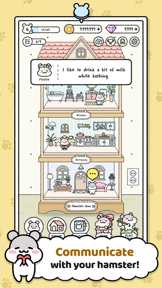


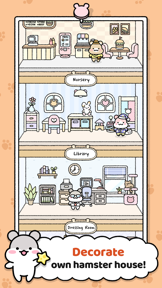
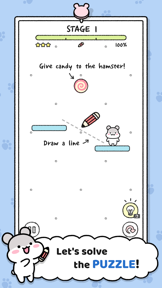


Hamster Town is a physics-based line-drawing puzzle game for casual mobile users, featuring hamster-house customization and pet-care meta-loops.
Product velocity
Active
Daily rank 🇺🇸
—
Games
Sentiment
4.0
28k reviews
Nemesis

DOP: Draw One Part
The App DNA
What makes this app unique?
Players hire the game for low-stress, healing puzzle experiences where the creative freedom of line-drawing provides a sense of agency that rigid puzzle games lack.
For Casual gamers and female demographic seeking relaxing, cute, and low-stress puzzle experiences.
What does it look like?
Key features
Players draw paths to deliver candy to hamsters, with hundreds of unique solutions per level
Players collect stars to build and decorate a virtual hamster house
Users raise and play with hamsters to earn rewards
Monetization through virtual goods and potential currency packs
How much does it cost?
Freemium model utilizing ad-supported gameplay and in-app purchases to monetize a casual puzzle audience.
Velocity
Active developmentShow more...
5 versions in history. Development pace: active.
Who built it?
Super Awesome
13+ apps tracked · Games
 헬로키티 프렌즈!
 Hello Kitty Friends
 Merge Safari
 Merge Monster Evolution
 Animal Craft 3D
 Merge Cute Pet
 Dino 2048
 Hamster Town: the Puzzle
 Animal Match 3D Fun
 Sweet Candy Blast: Toy Quest
 Octagon: Rolling Ball 360
 Ninja GO : Infinite Jump
User Sentiment
What do users think recently?
How are ratings & reviews evolving?
Not enough recent reviews to extract reliable themes yet.
Read the full review analysisCompetition
Competitive landscape for Hamster Town
How's the Games market?
The app maintains a high 4.72 rating on iOS, but the 3.96 rating on Android across 26,166 reviews signals significant technical or monetization friction on the platform.
Read the market outlookThe rivals identified
By SayGames LTD
This is the direct market leader in the 'draw-to-solve' puzzle niche, sharing the exact core mechanic of completing or modifying images via line drawing.
- Focuses on completing missing image segments rather than the physics-based delivery puzzles found in Hamster Town.
- Utilizes a high-frequency content update cycle that keeps the puzzle library fresh for casual daily users.
- Monetization relies heavily on interstitial ad-breaks between short levels, contrasting with Hamster Town's house-building meta-game.




Unlock the head-to-head verdict: where this rival wins, and where it loses.
Access the full report for freeThe Analyst's Read
Key takeaways for Hamster Town
Where is it heading?
The casual puzzle market is consolidating around live-ops-heavy titles, leaving static games like Hamster Town exposed to churn. Unless the team shifts from maintenance to a live-ops cadence, the current user base will migrate to competitors with fresher content.
- The Android rating gap indicates platform-specific technical friction, which compounds churn pressure from competitors with higher update cadences.
- Recent updates focused on technical improvements, suggesting the product is in maintenance mode rather than active feature expansion.
The SWOT
- Physics-based puzzle mechanics allow for multiple creative solutions per level
- Hamster-house meta-game drives long-term retention via collection loops
- Community-generated level editor could extend content life
- Live-ops event calendar could increase daily session frequency
Next best moves
Audit Android build stability because of the 0.76★ rating gap → close the platform sentiment disparity.
+ 1 more prioritized moveThe counter-intuitive read
The app's biggest risk is not its lack of features…
Read the full takeFeature gaps
Community-generated level editor (available in Brain It On! but missing here) +1
Since the last report: The analysis shifted from a feature-list overview to a critical evaluation of technical debt on Android and a lack of live-ops content compared to market rivals.
Bottom line
Hamster Town succeeds as a creative physics puzzle, but the Android rating gap and lack of live-ops content threaten its long-term retention, so the PM must prioritize technical parity and event-based engagement to defend against high-frequency rivals.
Unlock 2 critical frictions, 2 market threats, 1 more prioritized move and the analyst’s take.
Access the full report for freeReport last updated