


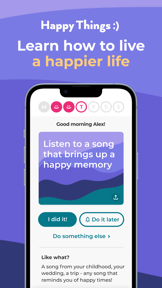


Happy Things is a mental wellness app offering science-based daily activities and cycle-syncing plans for women on iOS and Android.
The App DNA
What makes this app unique?
Users hire Happy Things to build consistent mental wellness habits through bite-size, personalized practices that fit into a daily routine.
For Women seeking science-based, personalized mental wellness solutions that account for hormonal and lifestyle factors.
What does it look like?
Key features
Mental wellness activities adjusted based on hormonal fluctuations and menstrual cycle data.
Curated library of 100+ bite-size, science-based practices for mood and stress management.
How much does it cost?
Subscription model anchored at $59.99/year, utilizing a 7-day free trial to lower the barrier for initial conversion.
Velocity
Dormant developmentopaqueShow more...
The app has been inactive for over two years, with the most recent release occurring on April 22, 2024. There is no evidence of ongoing development, feature updates, or live operations. The release history indicates a complete cessation of activity, classifying the app as a zombie project.
Who built it?

User Sentiment
What do users think recently?
Review voice lately leans frustrated. Users appreciate the core application concept provides high utility for users seeking this specific service.
How are ratings & reviews evolving?
What users say, by theme
- The core application concept provides high utility for users seeking this specific service
- Mandatory subscription paywalls for basic features create significant friction during the initial setup
2 of 2 recent reviews analyzed · limited sample
Read the full review analysisCompetition
Competitive landscape for Happy Things :)
How's the Health & Fitness market?
Happy Things competes in the Health & Fitness category, where its $59.99/year annual price point exceeds the median for single-purpose habit apps. The lack of a free-tier value proposition creates a conversion hurdle against broader health platforms.
Read the market outlookThe rivals identified

By BEGAMOB GLOBAL LIMITED
iCardiac competes directly for the health-conscious user by bridging the gap between daily mood habits and physiological health metrics.
- Integrates clinical-grade heart rate and HRV monitoring which Happy Things currently lacks entirely.
- Provides AI-driven doctor insights that offer a higher perceived value than simple daily activities.
- Includes a comprehensive food calorie tracker, expanding the app's utility beyond just mental wellness.
 Daily Mood Tracker - Self CareContender
 MoodWheelContender
 Worry Watch: Anxiety & MoodContender
 Thinkable HealthContender
Unlock the head-to-head verdict: where this rival wins, and where it loses.
Access the full report for freeThe Analyst's Read
Key takeaways for Happy Things :)
Where is it heading?
Users report: The mental wellness market is consolidating around platforms that offer both habit-tracking and physiological data, leaving single-purpose apps like Happy Things exposed. Unless the app shifts to a freemium model to capture a larger user base, it will struggle to compete against broader health ecosystems.
- The immediate subscription paywall post-install creates high churn risk, which limits the growth of the user base needed to sustain the business model.
- Lack of clinical-grade tracking leaves the app exposed to broader health competitors that offer higher perceived value for the same price point.
The SWOT
- Cycle-syncing wellness plans provide a specific differentiator for the female demographic
- Education partnerships untapped as B2B distribution channels for wellness programs
Next best moves
Implement a limited free-tier experience because users report being blocked by unexpected subscription requirements immediately after installation → increase new-user conversion.
The counter-intuitive read
The app's narrow focus on happiness habits is…
Read the full takeFeature gaps
Clinical-grade heart rate and HRV monitoring (available in iCardiac but missing here) +1
Since the last report: The app's competitive assessment has sharpened, focusing on the threat posed by clinical-grade health platforms and the resulting devaluation of its single-purpose habit-tracking model.
Bottom line
Happy Things provides a specialized habit-forming niche, but the immediate subscription paywall blocks the funnel, so the PM should prioritize a limited free-tier experience to improve conversion rates.
Unlock 1 critical friction, 1 market threat and the analyst’s take.
Access the full report for freeSources
- [1] App Store listing and reviews, source
Report last updated