


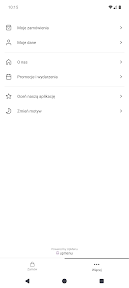


Haru Sushi is a direct-to-consumer ordering app for restaurants, enabling digital menu management and POS-integrated order processing on iOS and Android.
The App DNA
What makes this app unique?
Restaurant owners hire this app to reclaim delivery margins and customer data from third-party marketplaces, serving the need for a proprietary, commission-free digital storefront.
For Restaurant owners and franchise operators seeking to reduce reliance on third-party delivery commissions.
What does it look like?
Key features
Accepts food orders directly through a branded website or mobile app.
Syncs online orders directly into existing restaurant POS systems like Toast or Clover.
Automated rewards system that tracks customer purchases to incentivize repeat visits.
How much does it cost?
Subscription model scales costs with order volume to align with restaurant revenue growth.
Velocity
Maintenance developmentperformanceopaqueShow more...
The app ships approximately 0.12 releases per week, placing it firmly in the maintenance tier. Development is currently limited to minor bug fixes and performance improvements, with no evidence of new features or live operations. The release history shows a stable but slow cadence, with the most recent update occurring in December 2025. There has been no significant feature development since the initial release.
Who built it?
UpMenu
13+ apps tracked · Food & Drink
 foodbox app
 CUBANA
 Just Burger app
 YOMAYO SUSHI
 La Fabbrica
 Demo App
 Pizza Na Wypasie
 Komesushi
 Chicago's Pizza
 Strusinianka
 LA PASTA
 BAR FRASSES
User Sentiment
What do users think recently?
How are ratings & reviews evolving?
Not enough recent reviews to extract reliable themes yet.
Read the full review analysisCompetition
Competitive landscape for Haru Sushi
How's the Food & Drink market?
Haru Sushi functions as a white-label ordering tool for independent restaurants, competing against marketplace aggregators that hold dominant share-of-wallet. The platform's value hinges on commission-free transactions, which creates a price-based moat against third-party delivery platforms.
Read the market outlookThe rivals identified

By Uber Technologies, Inc.
Uber Eats competes directly for the same digital ordering share-of-wallet, leveraging a massive multi-category marketplace that Haru Sushi cannot match in scale.
- Offers a multi-category marketplace including groceries and retail, far exceeding Haru Sushi's single-brand menu focus.
- Provides real-time GPS order tracking and delivery logistics that Haru Sushi's basic app lacks entirely.
- Leverages the Uber One subscription model to drive high-frequency repeat purchasing behavior across all categories.
 Red Lobster Dining Rewards AppContender
 Caviar - Order Food DeliveryContender
 ChowNow: Local Food OrderingContender
 Koji ExpressContender
Unlock the head-to-head verdict: where this rival wins, and where it loses.
Access the full report for freeThe Analyst's Read
Key takeaways for Haru Sushi
Where is it heading?
The restaurant ordering market is consolidating around platforms that offer both direct-to-consumer tools and hybrid delivery logistics. Haru Sushi remains exposed to marketplace aggregators that offer superior discovery, so the platform must prioritize operational parity to retain its independent restaurant base.
- The platform maintains a steady release cadence focused on core ordering, which provides stability but lacks the aggressive feature expansion seen in marketplace rivals.
The SWOT
- POS integration with Toast and Clover reduces manual order entry for restaurant staff
- Commission-free transaction model preserves restaurant margins compared to third-party delivery marketplaces
- Integration of third-party delivery services could capture customers demanding hybrid fulfillment options
- Advanced meal customization features would improve parity with niche competitors like Koji Express
Next best moves
Ship real-time order tracking because it is a core expectation set by Uber Eats → improve user trust
+ 1 more prioritized moveThe counter-intuitive read
The lack of a massive user base is…
Read the full takeFeature gaps
Real-time GPS order tracking (available in Uber Eats but absent here) +2
Since the last report: The platform shifted its strategic focus toward operational parity with marketplace aggregators, prioritizing real-time tracking and support over loyalty features to address identified trust gaps.
Bottom line
Haru Sushi effectively captures restaurant margins through POS-integrated ordering, but it lacks the logistics and loyalty depth to retain casual diners against marketplace aggregators, so the PM should prioritize real-time tracking to close the competitive trust gap.
Unlock 2 critical frictions, 2 market threats, 1 more prioritized move and the analyst’s take.
Access the full report for freeReport last updated