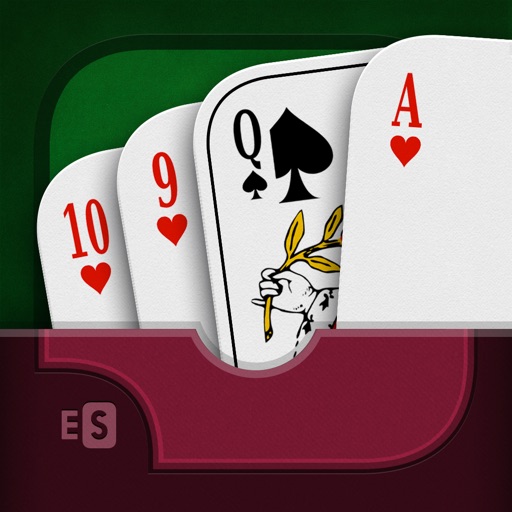


Hearts is a classic card game app for iOS and Android that offers solo AI play and local multiplayer modes.
The App DNA
What makes this app unique?
Users hire Hearts for a low-friction, offline-capable card experience that avoids the monetization pressure of modern gamified card apps.
For Card game enthusiasts looking for both solo practice against AI and social play with friends.
What does it look like?
Key features
Supports Wi-Fi or Bluetooth connections for direct player-to-player matches on iOS.
Simulated players programmed with Hearts-specific strategies and difficulty settings.
Uses Apple Game Center for matchmaking, leaderboards, and achievements.
How much does it cost?
Monetization relies on ad-inventory across a free-to-play model with no explicit paid-tier gates.
Velocity
Active developmentShow more...
5 versions in history. Development pace: active.
Who built it?
Eryod Soft
13+ apps tracked · Games
 President (King & Scum, Ahole)
 French Coinche +
 President (King & Scum, Ahole)
 French Tarot +
 Rummy
Rummy Crazy Eights
 French Belote
 Gin Rummy
 French Tarot
 Coinche / Belote Contrée
 Rummy +
 Solitaire (Klondike)
User Sentiment
What do users think recently?
How are ratings & reviews evolving?
Not enough recent reviews to extract reliable themes yet.
Read the full review analysisCompetition
Competitive landscape for Hearts
How's the Games market?
Hearts maintains a presence across multiple international markets, appearing in the top 100 Free categories in regions like Denmark and Luxembourg. The lack of a top-tier Grossing rank signals that monetization is not keeping pace with discovery.
Read the market outlookThe rivals identified

By MobilityWare
This is the dominant market leader in the Hearts niche, maintaining a massive user base and high-frequency update cycle.
- Offers a highly polished, standardized UI that sets the industry expectation for casual card players.
- Maintains a consistent release cadence of six updates per six months to ensure platform stability.
- Leverages a massive, established user base that creates a significant barrier to entry for new competitors.

Unlock the head-to-head verdict: where this rival wins, and where it loses.
Access the full report for freeThe Analyst's Read
Key takeaways for Hearts
Where is it heading?
The casual card market is consolidating around apps that blend classic mechanics with persistent meta-games. Hearts remains stable as a classic utility, but without a shift toward gamified retention, it risks losing its remaining share to more aggressive, feature-rich entrants.
- Recent updates focus on stability and OS compatibility, signaling a maintenance-mode posture rather than active feature expansion.
- The absence of IAP-driven progression paths limits revenue growth, leaving the app vulnerable to better-monetized competitors.
The SWOT
- Local multiplayer connectivity functions as a social retention lever without requiring internet access.
- Advanced AI difficulty settings provide solo play depth for classic card enthusiasts.
- Meta-game layer integration could increase daily active usage beyond current classic-play limits.
- Tournament-style events could drive social engagement and increase session frequency.
Next best moves
A/B test meta-progression rewards because current retention relies solely on classic gameplay → increase session frequency.
+ 1 more prioritized moveThe counter-intuitive read
The app's lack of modern gamification is not…
Read the full takeFeature gaps
Persistent meta-game progression (available in Solitaire Grand Harvest but missing here) +1
Since the last report: The app transitioned from a basic free-to-play utility to a freemium model, with a new focus on its competitive vulnerability to gamified card apps.
Bottom line
Hearts maintains a loyal base through classic, offline-capable play, but the lack of meta-progression leaves it exposed to gamified rivals, so the PM should prioritize a light meta-game layer to boost retention.
Unlock 2 critical frictions, 2 market threats, 1 more prioritized move and the analyst’s take.
Access the full report for freeReport last updated