





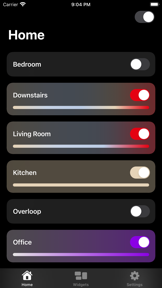

Hue Widgets is an iOS utility app providing Home Screen scene control for Philips Hue lighting systems.
The App DNA
What makes this app unique?
Users hire this app to bypass the primary Hue app's navigation friction for rapid, daily lighting adjustments.
For Philips Hue smart lighting users who prioritize quick, accessible control of their home environment directly from their phone home screen.
What does it look like?
Key features
Direct control of Hue scenes and light states from the iOS Home Screen
Toggle power for individual rooms or the entire home via widget configuration
Full feature set navigation compatible with iOS screen reader technology
How much does it cost?
Freemium model uses a feature-gated approach, restricting multi-room control to the paid version to drive conversion.
Velocity
Dormant developmentmonetizationShow more...
The app has not received a release in two years, indicating a complete cessation of development activity. With no updates since June 2024, the project is classified as a zombie. There is no evidence of ongoing maintenance, feature development, or live operations.
Who built it?
Pim Nijman
3 apps tracked · Utilities
 Hue for Watch
 Wave • Contraction Timer
User Sentiment
What do users think recently?
How are ratings & reviews evolving?
Not enough recent reviews to extract reliable themes yet.
Read the full review analysisCompetition
Competitive landscape for Hue Widgets
How's the Utilities market?
The app maintains a 3.75 rating across 24 total ratings, reflecting a niche utility position in the Utilities category. The lack of recent feature additions suggests a maintenance-mode posture that risks losing ground to multi-brand automation suites.
Read the market outlookThe rivals identified

By S-Labs sp. z o.o.
Appartme competes by offering a comprehensive smart home ecosystem that encompasses lighting, climate, and utility management, directly challenging Hue Widgets' narrow focus on scene control.
- Provides a unified dashboard for climate and utility management beyond simple lighting scene triggers.
- Features robust device sharing capabilities that allow multiple household members to manage home settings.
- Maintains a high release cadence with five updates in six months, ensuring platform stability.


Unlock the head-to-head verdict: where this rival wins, and where it loses.
Access the full report for freeThe Analyst's Read
Key takeaways for Hue Widgets
Where is it heading?
The smart home utility market is consolidating around multi-brand controllers that offer unified management, leaving single-brand apps like Hue Widgets exposed. Without a shift toward broader interoperability, the app will likely remain a niche tool for power users rather than a mass-market automation solution.
- The app remains in maintenance mode with no recent feature additions, signaling a lack of active investment in the current market cycle.
- Competitors like Appartme are increasing their release cadence, which threatens to erode Hue Widgets' market share among users seeking holistic home management.
The SWOT
- VoiceOver accessibility implementation enables a distinct user segment
- Home Screen widget focus reduces interaction friction for daily lighting tasks
- Expansion into wearable complications for glanceable control
- B2B partnerships with smart-home installers for pre-configured widget setups
Next best moves
Audit multi-brand support feasibility because competitors like Intelligent Home Center capture broader automation intent → increase addressable market
+ 1 more prioritized moveThe counter-intuitive read
The app's narrow focus on Philips Hue is…
Read the full takeFeature gaps
Multi-brand hardware interoperability (available in Intelligent Home Center but absent here) +1
Since the last report: The report shifts focus from internal technical stability to external competitive threats posed by multi-brand smart home ecosystems.
Bottom line
Hue Widgets holds a functional lead in Home Screen scene control, but its Philips-only restriction limits growth against multi-brand competitors, so the PM should prioritize hardware interoperability to prevent churn to unified smart home dashboards.
Unlock 2 critical frictions, 2 market threats, 1 more prioritized move and the analyst’s take.
Access the full report for freeReport last updated