


Human Anatomy AR

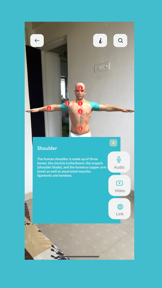


Human Anatomy AR is an educational tool for students to explore 3D body systems via augmented reality on iOS.
The App DNA
What makes this app unique?
Users hire this app for spatial anatomy visualization that 2D textbooks cannot provide, serving as a supplementary reference for English and Arabic-speaking students.
For Students and educators seeking interactive 3D tools for human anatomy study in English and Arabic speaking regions.
What does it look like?
Key features
Projects anatomical models into the user's physical space using AR camera tracking
Provides anatomical information and labels in both English and Arabic
How much does it cost?
The app is currently free with no visible IAP or subscription gates, functioning as a portfolio showcase for the developer's AR capabilities.
Velocity
Dormant developmentopaqueShow more...
The app has not received a single update in over three years, indicating a complete cessation of development. With no release activity since August 2022, the project is classified as a zombie. There is no evidence of ongoing maintenance, feature development, or live operations.
Who built it?
User Sentiment
What do users think recently?
How are ratings & reviews evolving?
Not enough recent reviews to extract reliable themes yet.
Read the full review analysisCompetition
Competitive landscape for Human Anatomy AR
How's the Education market?
The app occupies a niche visual-aid segment in the Education category, but lacks the curriculum-aligned exam tools that drive high-frequency usage in competing study apps.
Read the market outlookThe rivals identified

By StudySwitch, Inc.
This app competes directly for the student demographic by offering structured science curriculum support, challenging our AR-based anatomy tool for study time and user attention.
- Massive user base and high review volume create a significant social proof and trust barrier
- Curriculum-aligned question banks provide measurable academic progress that our AR visualization currently lacks
- Ad-free subscription model offers a clear, predictable monetization path compared to our current free-only model
 Tako Octo's Deep Sea AdventureContender
 Grade 12 Life SciencesContender
 Grade 11 Physical ScienceContender
 GeoForge AcademyContender
Unlock the head-to-head verdict: where this rival wins, and where it loses.
Access the full report for freeThe Analyst's Read
Key takeaways for Human Anatomy AR
Where is it heading?
The education market is consolidating around apps that provide measurable academic progress, leaving static visualization tools like Human Anatomy AR exposed. Without a shift toward active learning, the app will likely remain a low-frequency reference tool rather than a primary study platform.
- The lack of recent feature updates suggests the app is in maintenance mode, which allows curriculum-focused rivals to capture the student user base.
- The bilingual AR support remains a unique differentiator, but it requires active curriculum integration to translate into long-term student retention.
The SWOT
- Bilingual AR interface captures regional segments ignored by Japanese-only competitors
- 3D spatial visualization provides superior anatomical clarity over 2D text
- Integration of curriculum-based quizzes could convert passive viewers into daily active users
- B2B licensing for schools remains an untapped distribution channel
Next best moves
Ship curriculum-aligned quiz modules because current passive viewing fails to retain students against study-focused rivals → increase daily active usage
The counter-intuitive read
The app's lack of monetization is a strategic…
Read the full takeFeature gaps
Curriculum-aligned question banks (available in 中学理科 but absent here) +2
Since the last report: The competitive intelligence focus has shifted from professional medical atlas comparison to curriculum-aligned study app benchmarking, highlighting the app's lack of assessment and retention mechanics.
Bottom line
Human Anatomy AR provides high-utility spatial visualization, but lacks the curriculum-aligned assessment tools required to compete for student study time, so the PM should prioritize integrating quiz modules to build a retention loop.
Unlock 3 critical frictions, 2 market threats and the analyst’s take.
Access the full report for freeReport last updated