


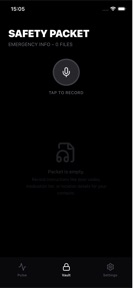
IfEver is an offline-first safety monitoring tool for solo travelers and individuals living alone, structured as a one-time purchase on iOS.
The App DNA
What makes this app unique?
It removes the cognitive cost of manual check-ins by using passive step detection to reset safety timers, serving users who require privacy without cloud dependency.
For Solo travelers, hikers, and individuals living alone who require a privacy-focused, offline-capable safety monitoring tool.
What does it look like?
Key features
Automated safety timer reset via step detection.
Local storage of encrypted safety data.
Pre-configured voice notes for trusted contacts.
How much does it cost?
The one-time $2.99 purchase model removes subscription friction and aligns with the offline-first, privacy-focused value proposition.
Velocity
Dormant developmentperformanceUX improvementsShow more...
With no updates in 223 days, the app has entered a state of inactivity. The last release focused on technical stability, including audio playback fixes and storage path adjustments, alongside a minor logic update for check-in frequency. There is no evidence of ongoing development or active maintenance cycles.
Who built it?
天 解
4 apps tracked · Utilities
 GMRS Tactical: Radio Guide
 ScopeZero: Turret Calculator
 RV Leveler Pro: Camper Tools
User Sentiment
What do users think recently?
How are ratings & reviews evolving?
Not enough recent reviews to extract reliable themes yet.
Read the full review analysisCompetition
Competitive landscape for IfEver: Personal Safety Net
How's the Utilities market?
IfEver occupies a specialized utility niche focused on offline privacy. The lack of recent updates over the last 223 days signals a maintenance-only posture that limits its ability to compete with OS-level safety features.
Read the market outlookThe rivals identified
Unlock the deeper market read.
Access the full report for freeThe Analyst's Read
Key takeaways for IfEver: Personal Safety Net
Where is it heading?
The safety-utility market is consolidating around OS-level features, leaving independent tools like IfEver exposed. The lack of recent updates suggests the developer is not prioritizing the feature expansion needed to maintain a competitive edge against native platform solutions.
- The seven-month development gap signals a maintenance-only posture, which erodes user trust in a safety-critical tool that requires constant platform compatibility updates.
- The one-time purchase model provides a stable, low-friction entry point for privacy-conscious users, though it lacks the recurring revenue to fund active feature expansion.
The SWOT
- Zero-interaction monitoring via step detection
- Local-only data storage provides privacy barrier
- Automated location-sharing triggers for trusted contacts
- Dead-man's switch widget for home screens
Next best moves
Pivot the roadmap to include automated location-sharing triggers because the current manual-only SOS limits utility in high-danger scenarios → increase user retention
+ 1 more prioritized moveThe counter-intuitive read
The offline-first design is a retention lever in…
Read the full takeSince the last report: The product strategy has shifted from maintenance to a defensive pivot, with new roadmap priorities focused on automated location-sharing to counter the encroachment of native OS-level safety features.
Bottom line
IfEver serves a niche segment requiring total privacy, but the seven-month development gap leaves the app vulnerable to OS-level safety features that now offer similar functionality natively. A pivot toward automated location-sharing triggers would unlock higher utility for the solo-traveler segment.
Unlock 2 critical frictions, 2 market threats, 1 more prioritized move and the analyst’s take.
Access the full report for freeFAQ
Is IfEver safe to use as my only emergency tool?
Does IfEver require an internet connection to work?
How does IfEver compare to built-in phone safety features?
What happens to my data if I delete the app?
Sources
- [1] App Store, source
Report last updated