


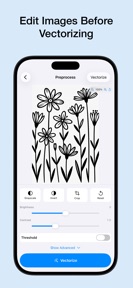


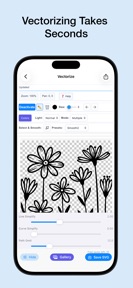


Image to Vector is a graphics utility for iOS that converts images into SVG vector files using local device processing.
The App DNA
What makes this app unique?
It removes the privacy risk and connectivity dependency inherent in cloud-based vector converters, serving designers who require secure, offline workflows.
For Graphic designers, illustrators, and UI/UX professionals who require local, offline conversion of sketches and photos into scalable vector assets.
What does it look like?
Key features
Converts images to SVG vectors locally on the device without cloud connectivity, ensuring privacy.
Applies specific vectorization styles including hand-drawn, posterized, and color-preserved outputs.
Adjusts line smoothness, curve precision, and edge detection sensitivity for manual refinement.
How much does it cost?
The app is currently distributed as a free utility with no visible monetization gates.
Velocity
Maintenance developmentUX improvementsperformanceShow more...
With only one release in the observed window, the app operates at a maintenance cadence of approximately one update every two months. Development is currently focused on incremental UI improvements and stability rather than significant feature expansion. There is no evidence of a live-ops strategy or frequent content updates. The current trajectory suggests a stable but slow development cycle.
Who built it?
User Sentiment
What do users think recently?
How are ratings & reviews evolving?
Not enough recent reviews to extract reliable themes yet.
Read the full review analysisCompetition
Competitive landscape for Image to Vector
How's the Graphics & Design market?
Image to Vector operates as a niche, free-to-use utility in the Graphics & Design category. The absence of monetization or user ratings suggests a development phase focused on utility rather than market share acquisition.
Read the market outlookThe rivals identified
Unlock the deeper market read.
Access the full report for freeThe Analyst's Read
Key takeaways for Image to Vector
Where is it heading?
The market for mobile vectorization is shifting toward subscription-based cloud services, leaving Image to Vector's offline-first approach as a distinct but unmonetized alternative. Without a clear revenue path, the app risks falling behind as competitors iterate on their feature sets using subscription-funded capital.
- The app remains in a maintenance phase with no major feature updates in the last two months, signaling a focus on stability over growth.
- The absence of a monetization model limits the developer's ability to fund future development, creating a long-term risk of abandonment.
The SWOT
- Local processing architecture ensures 100% data privacy, creating a barrier against cloud-dependent competitors
- Introducing a Pro tier with batch-processing could capture high-ARPU users currently relying on desktop tools
Next best moves
Implement a freemium model because the current free-only distribution provides no revenue to fund feature expansion → increase sustainability
+ 1 more prioritized moveThe counter-intuitive read
The lack of monetization is not a weakness…
Read the full takeSince the last report: Strategic focus has shifted from passive maintenance to active monetization planning, with the developer now identifying the lack of revenue as a primary risk to long-term product viability.
Bottom line
Image to Vector secures a defensible position through its offline-first architecture, but the lack of a monetization strategy prevents it from scaling as a commercial product. Establishing a clear revenue stream would allow the developer to fund the feature parity required to compete with established desktop-class vector converters.
Unlock 1 critical friction, 1 market threat, 1 more prioritized move and the analyst’s take.
Access the full report for freeFAQ
Is Image to Vector safe for professional design work?
Does Image to Vector require an internet connection?
What is the difference between Image to Vector and online converters?
Sources
- [1] App Store, source
Report last updated