


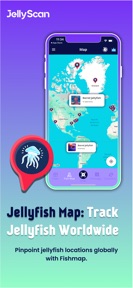

JellyScan is an AI-powered jellyfish identification and mapping tool for marine biology students and ocean enthusiasts on iOS.
The App DNA
What makes this app unique?
The app removes the cognitive friction of manual species identification by providing instant, camera-based classification and safety alerts for coastal explorers.
For Marine biology students, ocean researchers, and coastal explorers interested in jellyfish identification and marine life tracking.
What does it look like?
Key features
Camera-based identification engine for jellyfish species using trained marine biology datasets.
Geotagged map interface for tracking and viewing jellyfish sightings globally.
Educational profiles containing safety warnings for potentially dangerous jellyfish species.
How much does it cost?
JellyScan currently operates as a free tool with no visible subscription or IAP gates, focusing on user acquisition and community data growth.
Velocity
Maintenance developmentperformanceShow more...
JellyScan - Identify Jellyfish has seen no development activity for 159 days. With only one version release in the analyzed window, the app operates at a maintenance cadence. The latest release provided only generic performance optimizations and minor bug fixes, indicating a lack of active feature development or content expansion.
Who built it?
Dhaval Panasara
9 apps tracked · Education
 Live Earth Maps 3D GPS View
 Ambakaka 2.0: Gujarat Weather
 NFC Reader - Bank Card Wallet
 XAUUSD XAGUSD Signals Notifica
 WiFi Password Finder & Connect
 USA Gov Job & Nearby Vacancy
 Indian Calendar: Panchang
 Wifi Password Community
User Sentiment
What do users think recently?
How are ratings & reviews evolving?
Not enough recent reviews to extract reliable themes yet.
Read the full review analysisCompetition
Competitive landscape for JellyScan - Identify Jellyfish
How's the Education market?
JellyScan occupies a narrow niche in the Education category, currently maintaining a 4.6-star rating across a small sample of 5 reviews. The absence of recent feature updates suggests a focus on utility over aggressive market expansion.
The rivals identified
The Analyst's Read
Key takeaways for JellyScan - Identify Jellyfish
Where is it heading?
The marine biology education market is shifting toward integrated, real-time data platforms. JellyScan remains in a maintenance state, which leaves it exposed to larger, general-purpose nature identification apps that offer more frequent updates and broader species coverage.
- The five-month development gap indicates a maintenance-only posture, which prevents the app from scaling its community-driven mapping features against larger competitors.
- Stagnant release cadence limits the ability to address user feedback, which compounds the risk of churn in a niche category.
The SWOT
- AI-driven identification engine provides immediate species classification
- Geotagged Fishmap facilitates community-driven marine research
- Integration of real-time beach safety data for coastal tourists
- Partnerships with aquarium networks to improve AI accuracy
Next best moves
Ship a community-engagement event to drive map contributions because the Fishmap lacks density → increase user retention
The counter-intuitive read
The lack of monetization is not a weakness…
Read the full takeSince the last report: JellyScan maintains a static development posture, with no feature or pricing changes observed. The primary shift is in the analytical framing of the app's competitive strategy and the identification of external threats from general-purpose nature platforms.
Bottom line
JellyScan relies on its AI identification engine to provide value, but the current maintenance-only state prevents it from building the community network effects required for its mapping features. Shifting to a community-led event strategy would unlock the data density needed to sustain user interest.
Unlock 2 critical frictions, 2 market threats and the analyst’s take.
Access the full report for freeFAQ
Is JellyScan suitable for professional marine research?
Does JellyScan require an internet connection to identify jellyfish?
What are the alternatives to JellyScan for nature identification?
Sources
- [1] App Store, source
Report last updated