






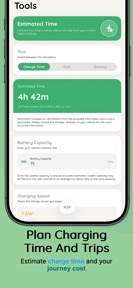


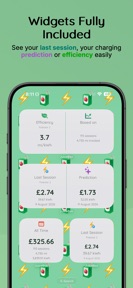

JuiceBox is a personal charging journal for EV drivers on iOS, designed to log session costs and energy usage manually.
The App DNA
What makes this app unique?
Drivers use JuiceBox to consolidate fragmented charging data from multiple public and home sources, removing the cognitive cost of tracking expenses across different provider apps.
For Electric vehicle owners who manage charging across multiple home and public infrastructure providers.
What does it look like?
Key features
Manual entry of kWh added, cost, and duration for home and public sessions.
On-device machine learning forecasts future charging costs and energy needs.
Separate or combined tracking for up to three electric vehicles.
How much does it cost?
The session-count cap on the free tier serves as the primary conversion lever for the annual Pro subscription.
Velocity
Maintenance developmentUX improvementsShow more...
The app currently ships at a maintenance cadence, with only one release recorded in the analyzed window. Development is focused on UX improvements, specifically addressing font scaling and UI component shapes. The latest release reflects a stable, low-frequency update pattern typical of a utility app in a maintenance phase. There is no evidence of live operations or rapid feature iteration.
Who built it?
User Sentiment
What do users think recently?
How are ratings & reviews evolving?
Not enough recent reviews to extract reliable themes yet.
Read the full review analysisCompetition
Competitive landscape for JuiceBox: EV Charging Log
How's the Utilities market?
JuiceBox occupies a niche utility space for manual EV charging tracking. With no significant ranking presence in the US Utilities category, the app relies on organic discovery rather than chart-driven acquisition.
Read the market outlookThe rivals identified
Unlock the deeper market read.
Access the full report for freeThe Analyst's Read
Key takeaways for JuiceBox: EV Charging Log
Where is it heading?
The EV charging utility market is shifting toward automated, API-first tracking that requires zero user input. JuiceBox remains exposed to this trend as long as it relies on manual entry, which will likely compress its user base as automated alternatives become more accessible.
- The latest release focuses on UI refinements, maintaining a maintenance-mode cadence with no new feature builds in the recent window.
The SWOT
- AI-driven prediction engine provides a differentiated value proposition for power users
- Multi-vehicle tracking capability targets high-value household segments
- Integration with vehicle-specific APIs could remove manual entry friction
Next best moves
Integrate vehicle-specific APIs because manual logging is a high-friction barrier → increase daily active usage
The counter-intuitive read
The manual logging requirement is not just a weakness…
Read the full takeBottom line
JuiceBox provides a stable manual logging utility, but the lack of automated vehicle connectivity limits its long-term retention potential. Prioritizing vehicle API integration would unlock the automation users expect, shifting the product from a manual journal to a passive tracking utility.
Unlock 2 critical frictions, 1 market threat and the analyst’s take.
Access the full report for freeFAQ
Is JuiceBox free to use?
Does JuiceBox automatically track my charging sessions?
Can I track more than one electric vehicle?
Sources
- [1] App Store, source
Report last updated