


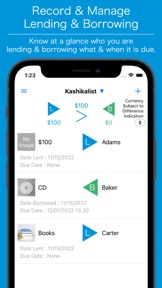


Kashikalist is a personal ledger app for tracking lent and borrowed items or money, available on iOS and Android.
The App DNA
What makes this app unique?
Users open Kashikalist to resolve the friction of forgotten social debts, replacing informal memory or fragmented notes with a centralized, searchable record.
For Individuals managing personal loans, borrowed items, or shared expenses among friends and acquaintances.
What does it look like?
Key features
Records item names, monetary amounts, and due dates to track obligations.
Calculates net balances between lent and borrowed items.
Alerts users of upcoming due dates to prevent missed repayments.
How much does it cost?
Monetization relies entirely on ad-inventory within a free-to-use utility model.
Velocity
Intense developmentShow more...
5 versions in history. Development pace: intense.
Who built it?
Akihiro Usui
7 apps tracked · Lifestyle
 MinimalLauncher
 groupay - Adjust Split Bill
 Recodarts
 Calphace
 Firstext
 CalCs - Calendar Complications
User Sentiment
What do users think recently?
How are ratings & reviews evolving?
Not enough recent reviews to extract reliable themes yet.
Read the full review analysisCompetition
Competitive landscape for Kashikalist
How's the Lifestyle market?
Kashikalist maintains a niche position in the lifestyle category, focusing on manual debt tracking rather than the automated expense management seen in broader finance apps. The lack of recent major updates suggests a maintenance-mode posture that leaves it vulnerable to more active, AI-integrated competitors.
Read the market outlookThe rivals identified

By UNITED, Inc.
This app dominates the personal finance space by combining comprehensive expense tracking with high-engagement gamification, directly competing for the same user base looking to manage money and debts.
- Features extensive gamified content that significantly increases daily active usage compared to basic ledger apps
- Provides sophisticated visual analytics and reporting tools that offer deeper financial insights than simple lists
- Leverages a massive, established user base and brand recognition that creates a strong network effect
 Tag AccountBook - Manage moneyContender
 BeeCount - Simple LedgerContender
 AccountingBook - MyAsset LT V2Contender
 Expenses HousekeeperContender
Unlock the head-to-head verdict: where this rival wins, and where it loses.
Access the full report for freeThe Analyst's Read
Key takeaways for Kashikalist
Where is it heading?
The personal finance market is consolidating around automated, cloud-connected tools that reduce the cognitive load of bookkeeping. Kashikalist's current trajectory is stable but limited, as it lacks the retention mechanics to compete with gamified or AI-integrated rivals.
- The infrequent update cadence suggests a maintenance-only posture, which allows AI-driven competitors to capture the market's efficiency-seeking segment.
- Kashikalist remains a functional, offline-first tool that serves a specific, narrow use case for users who prioritize data privacy over convenience.
The SWOT
- URL scheme support enables external workflow integration
- Passcode lock secures sensitive financial data
- Automated recurring-debt reminders would increase utility
- Lightweight visual summaries could improve engagement
Next best moves
Ship cloud synchronization because data silos are a top friction point → increase retention
+ 1 more prioritized moveThe counter-intuitive read
The lack of cloud synchronization is a feature for privacy-conscious users…
Read the full takeFeature gaps
AI-powered screenshot bookkeeping (available in BeeCount but absent here) +2
Since the last report: Kashikalist pivoted its development focus from AI-assisted entry to cloud synchronization to address data silos. This shift acknowledges the growing competitive pressure from cloud-connected finance tools.
Bottom line
Kashikalist provides a stable, manual ledger for social debts, but the lack of cloud synchronization and automated entry limits its growth against modern finance rivals. Prioritizing data portability would unlock higher utility for users who currently view the app as a temporary solution.
Unlock 2 critical frictions, 2 market threats, 1 more prioritized move and the analyst’s take.
Access the full report for freeFAQ
Is Kashikalist free to use?
How does Kashikalist compare to Household account book?
Does Kashikalist sync data across devices?
What is a good alternative for automated bookkeeping?
Sources
- [1] App Store listing, source
Report last updated