


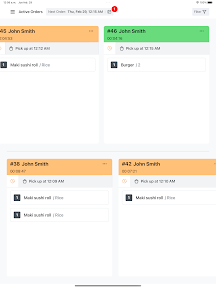


KDS is a digital kitchen display system for restaurants that replaces paper tickets with real-time order tracking and customer notifications.
The App DNA
What makes this app unique?
The platform removes the cognitive and physical friction of paper-based order management in high-volume kitchens.
For Restaurant owners and kitchen staff looking to digitize order management and improve customer communication.
What does it look like?
Key features
Eliminates the need for paper tickets by digitizing the order workflow.
Provides real-time feedback to customers regarding the status of their orders.
Allows kitchen staff to mark orders as done to trigger immediate customer alerts.
How much does it cost?
The app operates on a free model with no visible monetization, suggesting a focus on lead generation.
Velocity
Steady developmentShow more...
Who built it?
Crmb
13+ apps tracked · Food & Drink
 HAPPY TUMMIE
 Paleta Bar
 Food Truck League
 Dippys
 Lovebirds Hot Chicken
 Sip'n
Sip'n Lani's
 Donut NV
 Counter Cafe
 Byte Burger
 Pueblo Coffee Company
 The Red Food Truck
User Sentiment
What do users think recently?
How are ratings & reviews evolving?
Not enough recent reviews to extract reliable themes yet.
Read the full review analysisCompetition
Competitive landscape for KDS
How's the Food & Drink market?
KDS occupies a niche for independent operators, competing against comprehensive delivery-management suites like Zomato Restaurant Partner. The lack of recent updates (843 days) signals a product in maintenance mode, limiting its ability to challenge rivals that bundle marketing and sales reporting.
The rivals identified
By Zomato
Zomato dominates the restaurant management space by providing an end-to-end ecosystem that connects order management directly to a massive consumer delivery network.
- Massive network effect from millions of active users provides unparalleled order volume and data insights
- Integrated business management tools allow restaurants to handle menu updates and operations within one platform


Unlock the head-to-head verdict: where this rival wins, and where it loses.
Access the full report for freeThe Analyst's Read
Key takeaways for KDS
Where is it heading?
The restaurant management market is consolidating around platforms that offer end-to-end delivery and marketing tools. KDS remains stagnant, and without a clear roadmap for feature expansion, it will continue to lose relevance to competitors that provide granular sales reporting and POS integration.
- The 843-day update gap signals a lack of active maintenance, which erodes trust for potential restaurant partners.
The SWOT
- Lightweight architecture reduces hardware overhead for independent kitchens
- Target independent operators who find bloated delivery platforms restrictive
Next best moves
Audit current user base because 843 days have passed since the last update → determine if product sunset is necessary
The counter-intuitive read
The absence of delivery-network integration is often framed as a weakness…
Read the full takeFeature gaps
Marketing and store configuration tools (available in Hungerstation Partner but absent here) +1
Since the last report: The product outlook shifted from stable to declining, with the PM strategy moving from a pivot toward POS integration to a recommendation to sunset the app due to 843 days of inactivity.
Bottom line
The lack of updates for over two years indicates that KDS is no longer a viable competitor in the restaurant management space, and sunsetting the product would allow the team to reallocate resources to active projects.
Unlock 2 critical frictions, 1 market threat and the analyst’s take.
Access the full report for freeFAQ
Is KDS suitable for large restaurant chains?
How does KDS compare to Zomato Restaurant Partner?
Does KDS offer marketing or sales reporting tools?
What are some alternatives to KDS for kitchen management?
Sources
- [1] Play Store listing, source
Report last updated