


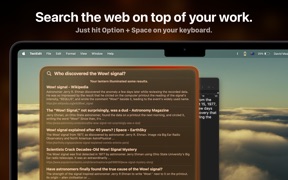



Lantern is a desktop utility that provides a floating, keyboard-triggered Google search bar for macOS users.
The App DNA
What makes this app unique?
Users hire Lantern to maintain their train of thought by performing quick web research without the context-switching cost of opening a full browser window.
For Desktop users who perform frequent web research and want to minimize context switching between their primary workspace and a browser.
What does it look like?
Key features
Persistent overlay window that remains visible over full-screen applications for immediate Google search access.
Configurable hotkey to summon the search interface without switching focus from active work.
How much does it cost?
Paid model anchored at $2.99, positioning the app as a low-cost utility alternative to browser-based search.
Velocity
Maintenance developmentplatform expansionUX improvementsperformanceShow more...
Lantern has transitioned into a maintenance phase, with only one release in the last 12 months. The development cadence is sporadic, with significant gaps between updates, such as the eight-month interval between the latest release and the previous version. Recent updates have focused primarily on platform expansion and compatibility fixes rather than new user-facing content. The app currently lacks a consistent release schedule, indicating a shift away from active feature development.
Who built it?
Luigi Mazzeo
13+ apps tracked · Reference
 Moment In Time - Clock
 Bored³ - Suggestions & Games
 Rapid Word Count
 The Particle Binder
 CounterPlusMinus
 Mikron - Mini Player for Music
 TouchRuler
 The Pinger
 Heart Tempo
 Noise Alerts
 Fluro: Retro Daily Organizer
 The Brief: News Articles
User Sentiment
What do users think recently?
Fresh user feedback skews excited. Users appreciate core search functionality provides reliable and fast information retrieval for daily mobile tasks and new ai-powered features assist users in organizing accounts and improving communication skills, but report voice recognition inaccuracies and forced language learning features disrupt user workflow efficiency.
How are ratings & reviews evolving?
What users say, by theme
- Core search functionality provides reliable and fast information retrieval for daily mobile tasks
- New AI-powered features assist users in organizing accounts and improving communication skills
- Voice recognition inaccuracies and forced language learning features disrupt user workflow efficiency
52 of 52 recent reviews analyzed · high confidence · Excited overall
Read the full review analysisUnlock 2 more frustration themes and 1 user request, each backed by review evidence.
Access the full report for freeCompetition
Competitive landscape for Lantern: Google Search Bar
How's the Reference market?
Lantern holds strong Tools category rankings in international markets, including #1 in China and #2 in Hong Kong. However, the $2.99 price point creates a conversion hurdle compared to free browser-native search tools.
Read the market outlookThe rivals identified

By The Browser Company of New York Inc.
Both apps target users seeking to minimize search friction and cognitive load during web research. Arc Search competes by offering a free, AI-native browsing experience that replaces traditional search results with synthesized summaries.
- Arc Search provides automated AI content synthesis; Lantern relies on standard Google search results.
- Arc Search offers a free, ad-free browsing experience; Lantern requires a $2.99 upfront purchase.
- Arc Search features automatic tab archiving; Lantern focuses on a persistent, keyboard-triggered desktop overlay.
Unlock the head-to-head verdict: where this rival wins, and where it loses.
Access the full report for freeThe Analyst's Read
Key takeaways for Lantern: Google Search Bar
Where is it heading?
The desktop search market is consolidating around browser-native AI assistants, which threatens the viability of standalone utilities. Lantern must leverage its lightweight, focus-oriented differentiator to survive, or it risks being marginalized by the feature-rich, free alternatives provided by browser giants.
- Browser-native AI search integration in Edge and Chrome reduces the utility of standalone search bars, accelerating churn pressure on Lantern's user base.
- Strong international ranking performance in the Tools category indicates a persistent demand for lightweight, focus-oriented search utilities among desktop power users.
The SWOT
- Keyboard-triggered overlay maintains user focus during research
- Lightweight footprint avoids resource overhead of full browsers
- Develop freemium tier to increase install velocity
- Integrate local document search to differentiate from browser rivals
Next best moves
Pivot to freemium model because $2.99 price point limits top-of-funnel growth → increase install velocity
+ 1 more prioritized moveThe counter-intuitive read
The $2.99 price point is not a weakness but a signal of intent…
Read the full takeFeature gaps
Conversational AI search (available in Microsoft Edge but absent here) +1
Bottom line
Lantern successfully solves the context-switching problem for power users, but its paid-upfront model limits mass adoption against free, AI-integrated browser alternatives, so the PM should prioritize a freemium pivot to capture a larger user base.
Unlock 2 critical frictions, 2 market threats, 1 more prioritized move and the analyst’s take.
Access the full report for freeSources
Report last updated