


Lost Trail - social hiking


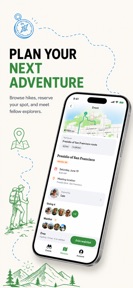

Lost Trail is a social hiking app for iOS that allows users to discover trails, host group events, and connect with local outdoor communities.
The App DNA
What makes this app unique?
The platform removes the friction of organizing group hikes by centralizing event coordination, meeting locations, and route planning in one interface.
For Outdoor enthusiasts and hikers looking to organize group outings or connect with local hiking communities.
What does it look like?
Key features
Visualizes hiking events and trails with filters, expanding potential ad-inventory by increasing time spent browsing local content.
Allows users to create public or private hikes and manage waitlists, increasing DAU/MAU ratios through repeat coordination.
Includes friend lists, direct messaging, and event comments, which increases switching costs via community network effects.
Enables users to plot custom paths, encouraging content creation that pulls non-users into the install funnel.
How much does it cost?
Lost Trail is currently free to use with no visible subscription or IAP gates.
Velocity
Maintenance developmentperformanceopaqueShow more...
Lost Trail maintains a maintenance-level cadence, shipping two updates over the last 38 days. Development is currently focused exclusively on performance and stability, with no new features or live-service content introduced in the recent history. The publisher utilizes opaque release notes, providing no insight into specific technical improvements or underlying changes. This pattern suggests a focus on long-term stability rather than active feature expansion.
Who built it?
Alexandr Peancovschi
8 apps tracked · Health & Fitness
 Redacted - hide sensitive part
 Editable Image Redactor
 Invoice maker, Quote builder
 Drift Mania infinite car racer
 Plant Care - Identify Flowers
 Professional Resume Builder
 One Shot - cocktail recipes
User Sentiment
What do users think recently?
How are ratings & reviews evolving?
Not enough recent reviews to extract reliable themes yet.
Read the full review analysisCompetition
Competitive landscape for Lost Trail - social hiking
How's the Health & Fitness market?
Lost Trail maintains a 5-star rating on the App Store, though this is based on a limited sample of one review. The lack of a monetization model positions it as a community-utility tool rather than a commercial fitness platform.
Read the market outlookThe rivals identified
Unlock the deeper market read.
Access the full report for freeThe Analyst's Read
Key takeaways for Lost Trail - social hiking
Where is it heading?
The outdoor fitness market is consolidating around platforms that integrate social coordination with high-fidelity navigation. Lost Trail remains exposed due to its lack of a revenue model, which limits the ability to iterate against better-funded navigation rivals.
- The monthly maintenance-only update cadence suggests the platform is currently in a stable state rather than an active growth phase.
- The absence of a monetization model limits the ability to scale infrastructure or invest in competitive feature parity.
The SWOT
- Custom route drawing tools function as a distribution barrier.
- Community-driven event hosting increases DAU/MAU ratios.
- Localized event discovery could be monetized through outdoor gear partnerships.
- Private event visibility allows for niche group growth.
Next best moves
Implement a freemium tier for advanced route drawing because current monetization is non-existent → increase long-term sustainability
+ 1 more prioritized moveThe counter-intuitive read
The lack of monetization is a strategic liability rather than a growth lever…
Read the full takeBottom line
Lost Trail relies on community-driven event coordination to drive retention, but the lack of a monetization model creates long-term sustainability risk. Implementing a revenue stream would unlock the resources needed to move beyond maintenance-mode updates.
Unlock 2 critical frictions, 1 market threat, 1 more prioritized move and the analyst’s take.
Access the full report for freeSources
- [1] App Store
Report last updated