


MindMap AI: AI Mind Map Maker
By 3axislabs



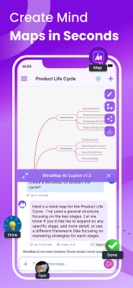

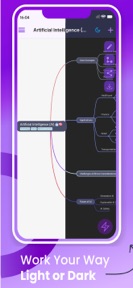


MindMap AI is a productivity tool for students and researchers that converts PDFs, videos, and notes into editable mind maps on iOS and Android.
The App DNA
What makes this app unique?
It removes the cognitive cost of manual summarization for dense academic material, allowing users to visualize complex relationships between sources without extensive re-reading.
For Students, researchers, and professionals who need to synthesize dense information from PDFs, transcripts, and meetings into visual structures.
What does it look like?
Key features
Generates structured visual maps from PDFs, videos, audio, and text prompts using context-aware AI.
Supports importing project files from Xmind, MindManager, SimpleMind, Freeplane, Mapify, Coggle, and FreeMind.
Allows users to drag, reorder, and rename nodes manually while maintaining AI-generated structure.
How much does it cost?
The credit-based usage model gates AI generation while keeping manual editing free to drive user acquisition.
Velocity
Maintenance developmentnew contentUX improvementsperformanceShow more...
MindMap AI currently operates at a maintenance cadence, with only one release shipped in the last 31 days. Development is focused on expanding utility through file format compatibility and UI refinements. The current pace suggests a stable, low-frequency update cycle rather than an aggressive feature-rollout strategy. Future updates are expected to follow this pattern of incremental improvements rather than rapid iteration.
Who built it?
User Sentiment
What do users think recently?
Fresh user feedback skews excited. Users appreciate ai-powered mind map generation from uploaded documents saves significant time for students and academic researchers and interactive ai assistant allows users to expand and refine nodes for deeper conceptual understanding during brainstorming.
How are ratings & reviews evolving?
What users say, by theme
- AI-powered mind map generation from uploaded documents saves significant time for students and academic researchers
- Interactive AI assistant allows users to expand and refine nodes for deeper conceptual understanding during brainstorming
- Unlimited hierarchy levels in mind maps provide superior depth compared to competing mapping applications
- High subscription costs and restrictive credit systems frustrate users who feel the pricing model is inaccessible
49 of 49 recent reviews analyzed · high confidence · Excited overall
Read the full review analysisUnlock 2 more frustration themes and 1 user request, each backed by review evidence.
Access the full report for freeCompetition
Competitive landscape for MindMap AI: AI Mind Map Maker
How's the Productivity market?
MindMap AI maintains a 4.0-star rating across 139 total platform reviews, reflecting a niche but satisfied user base. The current 31-day update cadence suggests a maintenance-focused development cycle that may struggle to keep pace with higher-velocity productivity competitors.
Read the market outlookThe rivals identified
Unlock the deeper market read.
Access the full report for freeThe Analyst's Read
Key takeaways for MindMap AI: AI Mind Map Maker
Where is it heading?
The productivity market is shifting toward native-speed AI integration, where users expect near-instant response times. MindMap AI's current maintenance-mode cadence and performance issues leave it exposed to faster-moving competitors, so the PM must prioritize engine stability to retain the academic user base.
- Performance lag during AI generation disrupts the user workflow, leading to input loss and increased churn risk.
- The latest release added third-party import support, addressing long-standing interoperability requests from power users.
The SWOT
- Multi-format document analysis (PDF, video, audio) creates a unique synthesis workflow.
- Unlimited hierarchy levels provide depth advantages over basic mapping tools.
- Cross-platform project imports reduce switching costs for existing mind-map users.
- Student-specific pricing tiers could reduce churn in the core academic segment.
- Optimizing server-side generation latency would directly improve daily active habit retention.
- Expanding export compatibility to include SVG and Markdown would satisfy power-user requests.
Next best moves
Optimize server-side generation latency because performance lag is a top-reported churn driver → increase session length
+ 1 more prioritized moveThe counter-intuitive read
The credit-based model is not just a monetization lever but a performance-management tool…
Read the full takeSince the last report: MindMap AI maintains a stable competitive posture, with no material changes to features, pricing, or user sentiment. The primary shift is a more granular articulation of the credit-based model's role in managing backend stability.
Bottom line
MindMap AI serves a clear academic need, but the credit-based pricing and performance instability currently cap its growth. Addressing the generation lag will unlock higher retention, as the core utility of PDF-to-map synthesis remains a strong differentiator for students.
Unlock 3 critical frictions, 3 market threats, 1 more prioritized move and the analyst’s take.
Access the full report for freeFAQ
Is MindMap AI free to use?
How does MindMap AI compare to other mind mapping tools?
Does MindMap AI work offline?
What are the best alternatives for students?
Sources
- [1] Play Store
Report last updated