


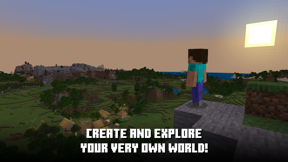
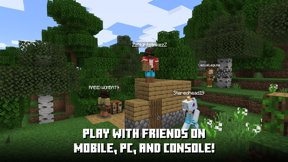


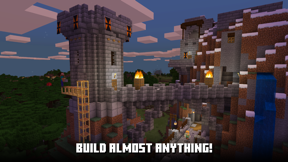


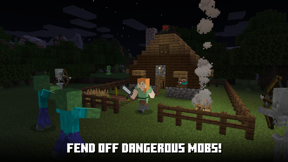

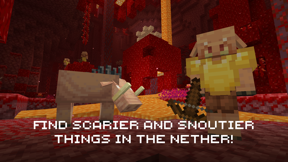
Minecraft: Play with Friends! is a cross-platform sandbox building and survival game for mobile, console, and PC users.
The App DNA
What makes this app unique?
Players use the platform to engage in persistent social multiplayer and creative expression, displacing isolated local-save alternatives.
For Players of all ages seeking sandbox building, survival gameplay, and social multiplayer experiences.
What does it look like?
Key features
Private, persistent server hosting for up to 10 players with cross-platform support.
In-game store for creator-made add-ons, skins, and worlds using Minecoins.
Multiplayer connectivity across mobile, console, and PC via Bedrock Edition.
How much does it cost?
Paid-upfront model at $6.99 per platform, supplemented by recurring subscription revenue for server hosting and IAP for digital goods.
Velocity
Intense developmentopaqueperformanceShow more...
The app maintains an intense development cadence, shipping 10 distinct versions over the observed window, averaging approximately 1.25 releases per week. Despite this high frequency, the developer consistently uses opaque release notes that cite only generic bug fixes, suggesting that feature rollouts or A/B testing may be managed via server-side flags rather than store-distributed code. The development trend remains stable and high-velocity, focusing entirely on maintenance and stability improvements. There is no evidence of new feature content or seasonal events in the provided release history.
Who built it?
Mojang
6 apps tracked · Games
 Minecraft Education
 Minecraft Sticker Pack
 Minecraft Education Preview
 Minecraft Education
 Minecraft Trial
User Sentiment
What do users think recently?
Review voice lately leans mixed. Users appreciate endless creative freedom in sandbox modes keeps players engaged across multiple years of play and multiplayer server experiences provide a social anchor that keeps the community active and returning, but report frequent application crashes on startup prevent users from accessing the game after the latest update.
How are ratings & reviews evolving?
Weekly average review rating
What users say, by theme
- Endless creative freedom in sandbox modes keeps players engaged across multiple years of play
- Multiplayer server experiences provide a social anchor that keeps the community active and returning
- Marketplace content and add-ons offer variety that keeps the gameplay loop fresh for veterans
- Frequent application crashes on startup prevent users from accessing the game after the latest update
120 of 41855 recent reviews analyzed · high confidence · Mixed overall
Read the full review analysisUnlock 2 more frustration themes and 3 user requests, each backed by review evidence.
Access the full report for freeCompetition
Competitive landscape for Minecraft: Play with Friends!
How's the Games market?
Minecraft: Play with Friends! holds the #1 Paid position across major global markets, including the US, UK, and Australia. The $6.99 price point remains a stable barrier that effectively filters for high-intent, long-term players compared to F2P rivals.
Read the market outlookThe rivals identified

By 505 Games (US), Inc.
Both apps compete for the same sandbox survival audience, utilizing paid pricing models to target players seeking long-term creative and survival gameplay loops.
- Terraria provides tactical boss combat controls; Minecraft: Play with Friends! lacks these specialized mobile inputs.
- Terraria includes a world seed system for replayability; Minecraft: Play with Friends! lacks this specific feature.
Unlock the head-to-head verdict: where this rival wins, and where it loses.
Access the full report for freeThe Analyst's Read
Key takeaways for Minecraft: Play with Friends!
Where is it heading?
The sandbox market is consolidating, but Minecraft's cross-platform network effects provide a significant buffer against F2P entrants. The immediate risk is technical debt: if the current startup and data-loading issues persist, the resulting churn will compress the long-term player base and reduce Marketplace transaction volume.
- Startup crashes and authentication loops prevent access, overshadowing recent content updates and driving negative sentiment.
- The core sandbox experience remains a strong retention anchor, keeping the app at the top of paid charts globally.
The SWOT
- Cross-platform network effects across mobile, console, and PC
- High-margin recurring revenue via Realms Plus subscriptions
- Localized pricing in high-ARPU markets
- Expanding creator-referral loops for Marketplace content
Next best moves
Rebuild authentication flow because login loops are a top-tier frustration theme → reduce session-start churn
+ 1 more prioritized moveThe counter-intuitive read
Minecraft's dominance is not threatened by feature-rich rivals…
Read the full takeFeature gaps
Tactical boss combat controls (available in Terraria but missing here) +1
Since the last report: Technical instability, specifically startup crashes and authentication loops, has triggered a sentiment downgrade from positive to mixed. This shift in user experience now overshadows the app's core sandbox retention, forcing a pivot in development priorities toward data persistence and login reliability.
Bottom line
Technical instability is currently the primary threat to Minecraft's market-leading position. Prioritizing authentication and data persistence will stabilize the core retention loop, allowing the team to refocus on Marketplace expansion and cross-platform feature parity.
Unlock 3 critical frictions, 2 market threats, 1 more prioritized move and the analyst’s take.
Access the full report for freeFAQ
Is Minecraft worth the $6.99 price tag?
How does Minecraft compare to Terraria?
Does Minecraft have intrusive ads?
What is a free alternative to Minecraft?
Sources
Report last updated