


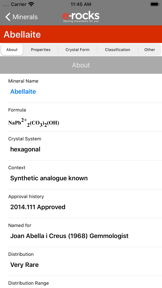

Mineralogy Database by e-Rocks is a reference and marketplace utility for mineral collectors and researchers on iOS.
The App DNA
What makes this app unique?
Users hire the app to access geological facts and manage collections, but the current navigation friction prevents the app from serving as a primary field tool.
For Mineral collectors, researchers, and dealers seeking a specialized marketplace and reference database for geological specimens.
What does it look like?
Key features
Searchable repository of 6200 mineral species including crystallography, chemistry, and classification data
Direct access to live mineral auctions and fixed-price sales from global sellers
Personalized online catalogue for managing collections, provenance, and storage data
How much does it cost?
Monetization is anchored in a tiered membership model that gates advanced selling and cataloging tools behind collector and dealer status.
Velocity
Dormant developmentopaqueShow more...
The app has not received a single update in over five years, indicating that development has ceased. There is no evidence of active maintenance, feature development, or live operations. The last recorded release occurred on 2021-03-18, and the project is effectively abandoned.
Who built it?
User Sentiment
What do users think recently?
Recent user voice shows an excited sentiment. Users appreciate detailed mineral descriptions provide educational value for both novice and experienced geology enthusiasts.
How are ratings & reviews evolving?
What users say, by theme
- Detailed mineral descriptions provide educational value for both novice and experienced geology enthusiasts
- Navigation flow breaks when returning from mineral detail pages to the main search interface
1 of 1 recent reviews analyzed · limited sample
Read the full review analysisCompetition
Competitive landscape for Mineralogy Database by e-Rocks
How's the Utilities market?
The app maintains a niche utility position for mineral collectors, but the lack of updates since 2021 and a 3.0-star rating indicate a stagnant competitive posture.
Read the market outlookThe rivals identified
Unlock the deeper market read.
Access the full report for freeThe Analyst's Read
Key takeaways for Mineralogy Database by e-Rocks
Where is it heading?
Users report: The mineralogy hobbyist market is shifting toward AI-driven identification and interactive field tools, leaving static database apps exposed. Without a refresh of the core navigation and feature set, the app will continue to lose the amateur segment to more modern, identification-focused rivals.
- Stalled update cadence since 2021 leaves the app vulnerable to competitors with modern AI-identification features, eroding the long-term competitive moat.
- Persistent navigation bugs in the search interface create friction for new users, which compounds the rating drag and limits organic growth.
The SWOT
- Collector portal membership gate increases switching costs via user-generated collection data
- Offline database access sustains utility for field researchers in remote locations
- AI-driven specimen identification could lower entry barriers for amateur collectors
- Wearable integration for field logging would capture professional geological data workflows
Next best moves
Rebuild search navigation flow because unresponsive scrolling is the top-reported complaint → restore discovery loop retention
+ 1 more prioritized moveThe counter-intuitive read
The app's lack of updates is a strategic…
Read the full takeFeature gaps
AI-driven mineral identification (available in Mineral Identifier AI but missing here) +2
Since the last report: The analysis now incorporates specific user-reported navigation bugs and shifts the strategic focus toward fixing search friction to improve retention.
Bottom line
The app provides high-value reference data but fails to retain users due to navigation friction and a lack of modern identification features, so the PM should prioritize fixing the search loop before pursuing AI-driven growth.
Unlock 2 critical frictions, 2 market threats, 1 more prioritized move and the analyst’s take.
Access the full report for freeReport last updated