


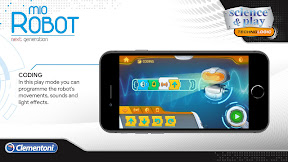


Mio, the Robot is a companion app for physical robotics hardware, designed to teach children basic coding and remote control via high-frequency audio signals.
The App DNA
What makes this app unique?
Users hire this app to bridge the gap between physical toy assembly and digital logical programming, seeking a low-barrier entry into robotics education.
For Children older than 8 years interested in robotics and programming basics.
What does it look like?
Key features
Direct manual command of robot movements, sounds, and light effects via app interface
Sequence-based command builder with conditional logic blocks for programming strings
Data transmission between mobile device and robot via inaudible high-frequency sound waves
How much does it cost?
The app functions as a free companion tool to drive sales of physical Clementoni robotics hardware.
Velocity
Steady developmentShow more...
Who built it?
Tinybop
13+ apps tracked · Educational
 Space by Tinybop
 The Human Body Lite
 The Robot Factory by Tinybop
 Skyscrapers by Tinybop
 The Earth by Tinybop
 Simple Machines by Tinybop
 Everything Machine by Tinybop
 The Infinite Arcade by Tinybop
 Mammals by Tinybop
 Creature Garden by Tinybop
 Homes by Tinybop
 The Monsters by Tinybop
User Sentiment
What do users think recently?
Recent user voice shows a frustrated sentiment. Users appreciate creative satisfaction during the initial construction phase of the robot hardware.
How are ratings & reviews evolving?
What users say, by theme
- Creative satisfaction during the initial construction phase of the robot hardware
- Connection failures between the mobile application and the robot hardware via wireless protocols
6 of 6 recent reviews analyzed · limited sample · Frustrated overall
Read the full review analysisUnlock 1 more frustration theme and 1 user request, each backed by review evidence.
Access the full report for freeCompetition
Competitive landscape for Mio, the Robot
How's the Educational market?
The app maintains a 4.1 rating on Android despite a 2.0 rating on iOS, signaling platform-specific technical debt that limits its reach.
Read the market outlookThe rivals identified
By LEGO
This is the direct market leader in the physical-to-digital robotics toy category, sharing the exact same 'toy-companion' app model as Mio.
- Leverages a massive global brand ecosystem that creates high switching costs for young users
- Provides a modular building system that allows for multiple robot configurations within one app
- Integrates complex visual programming blocks that scale better for older children than Mio's interface

Unlock the head-to-head verdict: where this rival wins, and where it loses.
Access the full report for freeThe Analyst's Read
Key takeaways for Mio, the Robot
Where is it heading?
The educational robotics market is shifting toward high-fidelity, gamified coding environments that offer immediate feedback. Mio remains exposed due to its reliance on hardware-dependent communication, so the PM must stabilize the app-to-robot link to retain the user base.
- Persistent connection failures between the app and hardware prevent core feature access, which compounds the negative sentiment observed in reviews.
- The physical assembly experience remains a strong engagement driver, providing a stable foundation for the product if the software handshake is fixed.
The SWOT
- High-frequency audio communication eliminates Bluetooth pairing complexity
- Physical assembly experience drives initial user satisfaction
- Free companion model lowers entry barrier for hardware owners
- Implement guided in-app tutorials for secondary modes
- Expand coding curriculum to include gamified challenges
- Add voice recording to increase interactive engagement
Next best moves
Rebuild audio-handshake logic because connection failures are the top complaint → increase successful session rate
+ 1 more prioritized moveThe counter-intuitive read
The app's reliance on high-frequency audio is a…
Read the full takeFeature gaps
Gamified coding challenges (available in LEGO Boost but missing here) +1
Since the last report: The analysis shifted from a high-level overview to a critical evaluation of technical instability and connectivity failures that threaten the product's core value proposition.
Bottom line
Mio, the Robot secures its hardware value through unique audio-based communication, but persistent connectivity failures erode the user experience, so the PM must prioritize handshake stability to prevent churn.
Unlock 3 critical frictions, 3 market threats, 1 more prioritized move and the analyst’s take.
Access the full report for freeReport last updated