


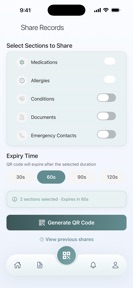


MyMed Access is a medical record storage and sharing tool for patients, available on iOS.
The App DNA
What makes this app unique?
Users report: Users hire MyMed Access to consolidate fragmented health records and share them with providers without the friction of traditional paper-based transfers.
For Patients seeking a centralized, digital repository for medical records and individuals requiring quick, secure access to health data for healthcare providers.
What does it look like?
Key features
Generates single-use, time-limited QR codes for providers to access specific patient records.
Extracts patient data from uploaded PDF lab reports using automated text recognition.
Displays critical health data like blood type and allergies via biometric bypass without internet connectivity.
How much does it cost?
The app is currently free with no subscription or IAP gates, positioning it as a utility tool.
Velocity
Maintenance developmentperformanceShow more...
MyMed Access currently operates on a maintenance cadence, shipping only minor bug fixes. With only one version released in the observed window, there is no evidence of new feature development or live operations. The development team appears focused exclusively on stability and performance maintenance rather than iterative feature growth.
Who built it?
User Sentiment
What do users think recently?
How are ratings & reviews evolving?
Not enough recent reviews to extract reliable themes yet.
Read the full review analysisCompetition
Competitive landscape for MyMed Access
How's the Medical market?
MyMed Access operates as a free utility tool within the Medical category, focusing on record portability rather than clinical interaction. The absence of subscription gates suggests a growth-first strategy, though it lacks the scale of integrated hospital-system portals.
Read the market outlookThe rivals identified
Unlock the deeper market read.
Access the full report for freeThe Analyst's Read
Key takeaways for MyMed Access
Where is it heading?
Users report: The medical record space is consolidating around platform-native health tools that automate data synchronization, leaving manual-entry apps like MyMed Access exposed. The team must shift from a utility-first to an integration-first strategy to avoid obsolescence as EHR systems become more accessible via standard APIs.
- Recent updates focus on stability, no feature expansion, signaling a maintenance-mode posture that risks falling behind platform-native health tools.
- The lack of a monetization model limits the ability to scale infrastructure, creating a long-term sustainability risk for user data storage.
The SWOT
- Single-use QR code mechanism eliminates manual record-sharing friction
- Biometric-bypass emergency mode provides critical utility for first responders
- HIPAA-compliant architecture establishes a baseline for data-sensitive B2B partnerships
- Partnering with independent clinics to standardize QR-based check-ins
- Expanding OCR capabilities to include insurance card and immunization record parsing
Next best moves
Ship direct EHR API integrations because manual uploads are the #1 barrier to user retention → increase daily active usage.
+ 1 more prioritized moveThe counter-intuitive read
The 'AI-powered OCR' feature is a liability, not an asset…
Read the full takeSince the last report: The app's strategic direction shifted from a passive utility to an integration-first roadmap, while the SWOT analysis now highlights significant competitive threats from platform-native health tools.
Bottom line
MyMed Access solves the immediate pain of record portability via QR sharing, but manual data entry creates a high churn risk, so the team must prioritize direct EHR integrations to remain relevant against platform-native health tools.
Unlock 3 critical frictions, 2 market threats, 1 more prioritized move and the analyst’s take.
Access the full report for freeSources
- [1] Developer website, source
Report last updated