


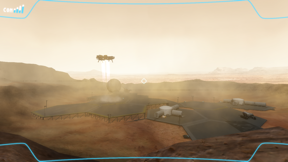

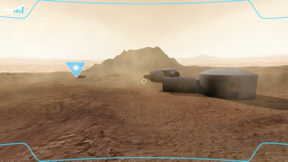
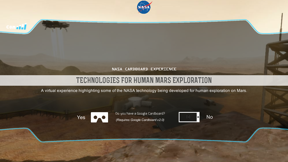
NASA Mars Cardboard Experience is an educational VR app for iOS that provides 360-degree views of Martian exploration technology.
The App DNA
What makes this app unique?
Users hire this app for low-stakes, immersive space exploration that provides a simple way to experience VR without expensive hardware.
For Students and space enthusiasts interested in NASA technology and Martian exploration.
What does it look like?
Key features
Immersive 360-degree visualization of Martian terrain and exploration technology.
Stereoscopic rendering optimized for Google Cardboard hardware.
Alternative viewing mode for users without VR hardware, utilizing standard screen interaction.
How much does it cost?
The app is distributed as a free educational tool with no observed monetization or in-app purchases.
Velocity
Dormant developmentperformanceShow more...
The app has effectively reached a zombie state, with no updates released in the last seven months. The latest version, released in December 2025, focused on a technical rebuild using the Cardboard open-source SDK to improve stability. Prior to this, the app saw no meaningful development activity for years, as the previous iOS update dates back to early 2017. There is no evidence of ongoing maintenance or active feature development.
Who built it?
NASA
13+ apps tracked · Education
 NASA
NASA NASA Visualization Explorer
 GLOBE Observer
 NASA NeMO-Net
 NASA SAFE
 Ascent: Commemorating Shuttle
 NASA's First Woman
 NASA Science: Plant Growth
 Rocket Science: Ride 2 Station
 Space Station Research Xplorer
 NASA HIAD
 Space365
User Sentiment
What do users think recently?
The recent review mood reads frustrated. Users appreciate immersive 360-degree visual experiences provide a compelling entry point for casual virtual reality enthusiasts, but report post-update stability issues cause frequent app crashes and unexpected exits during video playback sessions.
How are ratings & reviews evolving?
What users say, by theme
- Immersive 360-degree visual experiences provide a compelling entry point for casual virtual reality enthusiasts
- Post-update stability issues cause frequent app crashes and unexpected exits during video playback sessions
55 of 55 recent reviews analyzed · high confidence · Frustrated overall
Read the full review analysisUnlock 2 more frustration themes and 1 user request, each backed by review evidence.
Access the full report for freeCompetition
Competitive landscape for NASA Mars Cardboard Experience
How's the Education market?
NASA Mars Cardboard Experience maintains a presence in the Libraries & Demo category, holding the #6 slot in the US and #8 in Brazil. The high frequency of stability-related complaints suggests the current rank is driven by brand equity rather than product utility.
Read the market outlookThe rivals identified

By Noctua Software Ltd
Dominates the astronomy education niche with a massive user base and consistent, high-frequency feature updates.
- Provides real-time sky tracking with professional-grade sensor integration for precise celestial object identification.
- Maintains a massive, frequently updated database of stars and constellations that dwarfs static educational apps.
- Offers a robust cross-platform experience that supports both casual observation and advanced astronomical research.

Unlock the head-to-head verdict: where this rival wins, and where it loses.
Access the full report for freeThe Analyst's Read
Key takeaways for NASA Mars Cardboard Experience
Where is it heading?
The market for mobile astronomy and space education is consolidating around high-frequency, high-fidelity tools like Stellarium. Unless the team addresses the current stability regressions and hardware incompatibility, the app will continue to lose its relevance as a credible NASA educational resource.
- Stability regressions in the latest update (frequent crashes, navigation failures) erode the daily active habit, which compounds the rating drag already visible on Android.
- The lack of local content options and aggressive ads during playback drives negative sentiment, signaling a misalignment between the app's monetization and its educational mission.
The SWOT
- NASA-branded educational content provides immediate credibility
- Non-Cardboard view lowers the barrier to entry
- Integrating wearable support for third-party headsets
- Expanding local content options for offline playback
Next best moves
Audit Android device compatibility because users report broken QR code scanning on modern OS versions → restore core viewer access
+ 1 more prioritized moveThe counter-intuitive read
The app's reliance on legacy Cardboard hardware is not just a technical debt…
Read the full takeFeature gaps
Real-time sky tracking (available in Stellarium Mobile but absent here) +1
Bottom line
NASA Mars Cardboard Experience provides unique Martian content, but technical instability and ad-heavy design drive negative sentiment, so the PM should prioritize stability patches over new features to prevent total user abandonment.
Unlock 3 critical frictions, 2 market threats, 1 more prioritized move and the analyst’s take.
Access the full report for freeSources
Report last updated