

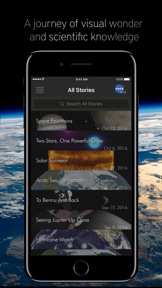

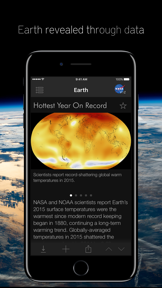
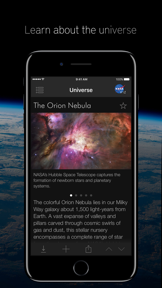

NASA Visualization Explorer is an educational app for space enthusiasts that provides mission updates, live streaming, and astronomical imagery on iOS and Android.
Product velocity
Dormant
Daily rank 🇺🇸
—
Education
Sentiment
4.3
119k reviews
Nemesis

Stellarium Mobile - Star Map
The App DNA
What makes this app unique?
Users hire the app for authoritative, ad-free access to space exploration data, but the current technical instability forces them to seek more reliable alternatives for daily engagement.
For Space enthusiasts, students, and educators seeking official mission updates and high-quality astronomical imagery.
What does it look like?
Key features
Live coverage of rocket launches, landings, and ISS events via NASA+ service
Access to over 21,000 images with automated daily phone wallpaper updates
How much does it cost?
The app operates as a public service with no subscription or IAP, focusing on brand authority and public engagement.
Velocity
Dormant developmentUX improvementsperformanceShow more...
The development history shows a extreme lack of activity, with a nearly 10-year gap between the 2016 release and the most recent update in April 2026. Given the lack of consistent release history, the app is classified as a zombie. The latest release provides minor functional updates, but there is no evidence of an ongoing development pipeline or operational cadence.
Who built it?
NASA
13+ apps tracked · Education
 NASA
NASA GLOBE Observer
 NASA NeMO-Net
 NASA SAFE
 Ascent: Commemorating Shuttle
 NASA's First Woman
 NASA Science: Plant Growth
 Rocket Science: Ride 2 Station
 Space Station Research Xplorer
 NASA HIAD
 Space365
 NASA Science: Humans in Space
User Sentiment
What do users think recently?
Recent user voice shows a mixed sentiment. Users appreciate educational content regarding space missions and scientific news keeps students and space enthusiasts engaged, but report persistent loading errors and server connectivity issues prevent users from accessing content across multiple platforms.
How are ratings & reviews evolving?
What users say, by theme
- Educational content regarding space missions and scientific news keeps students and space enthusiasts engaged
- Persistent loading errors and server connectivity issues prevent users from accessing content across multiple platforms
99 of 99 recent reviews analyzed · high confidence · Mixed overall
Read the full review analysisUnlock 1 user request, each backed by review evidence.
Access the full report for freeCompetition
Competitive landscape for NASA Visualization Explorer
How's the Education market?
The app maintains a high rating on Android despite technical instability, but the lack of updates since 2016 on iOS signals a platform-specific neglect that limits its reach.
Read the market outlookThe rivals identified
By Noctua Software Ltd
Dominates the astronomy education niche with a massive user base and high-frequency updates that directly challenge NASA's educational mission.
- Provides real-time, high-fidelity sky rendering that transforms the device into a professional-grade planetarium tool.
- Maintains a consistent release cadence of two updates per quarter, ensuring feature parity with modern mobile OS standards.
- Offers a premium subscription model that funds continuous development, unlike the static, legacy-feeling NASA app.



Unlock the head-to-head verdict: where this rival wins, and where it loses.
Access the full report for freeThe Analyst's Read
Key takeaways for NASA Visualization Explorer
Where is it heading?
The astronomy education market is consolidating around high-fidelity, frequently updated tools that offer professional-grade utility. NASA's current posture is exposed: without a shift toward infrastructure reliability and modern navigation, the app will continue to lose its relevance to competitors like Stellarium.
- Persistent server connectivity errors prevent content access, which directly erodes user trust and accelerates churn among the core educational audience.
- Recent updates focused on networking stability, but the lack of feature expansion leaves the app vulnerable to competitors with faster update cycles.
The SWOT
- Exclusive access to official NASA mission imagery
- Authoritative brand status in space education
- B2B distribution via classroom curriculum integration
- Wearable integration for real-time mission alerts
Next best moves
Rebuild server connectivity logic because loading errors are the #1 complaint → stabilize daily active usage
+ 1 more prioritized moveThe counter-intuitive read
The app's lack of monetization is a liability, not an asset…
Read the full takeFeature gaps
Real-time high-fidelity sky rendering (available in Stellarium Mobile) +1
Since the last report: The app broke a decade-long development silence with new streaming and wallpaper features, but technical instability and platform-specific performance gaps now define its competitive outlook.
Bottom line
NASA Visualization Explorer holds a unique position through official mission content, but persistent server instability erodes user trust, so the PM must prioritize infrastructure reliability to defend the app's authority against modern, high-fidelity competitors.
Unlock 3 critical frictions, 2 market threats, 1 more prioritized move and the analyst’s take.
Access the full report for freeReport last updated