


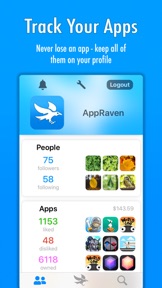


AppRaven is a community-curated app discovery and price-tracking platform for iOS users.
The App DNA
What makes this app unique?
It removes the friction of manually monitoring price drops for paid apps, serving users who want to build high-quality software libraries on a budget.
For Mobile users and bargain hunters looking to discover discounted apps and games on the App Store.
What does it look like?
Key features
Monitors app price changes and sends notifications when wish-listed items go on discount, driving ad-inventory exposure.
Users create and share curated lists of apps, pulling non-users into the install funnel via web previews.
Adds apps to the wish list directly from the App Store interface, reducing tracking friction.
How much does it cost?
The app operates as a free utility, likely monetizing through ad inventory generated by daily active usage and community engagement.
Velocity
Maintenance developmentperformanceopaqueShow more...
The app currently operates on a maintenance cycle, with the latest release occurring 98 days ago. Development is limited to minor stability and performance patches, with no new features or content updates identified in the recent history. The cadence of approximately one release every three months indicates a stable but low-velocity development effort focused exclusively on technical upkeep.
Who built it?
Simon Zvara
10 apps tracked · Shopping
 Termix: SSH Client & Terminal
 Demus: Easy Music Streaming
 CardBoard: Card & Board Games
 Termix Pro: SSH & SFTP Client
 YouPlay: AdBlock Video Browser
 Sigma: Your Feeds United
 LingoLite: Learn Languages
 RobotMania: Physics Sandbox
 RobotMania + Physics Sandbox
User Sentiment
What do users think recently?
Fresh user feedback skews mixed. Users appreciate curated app discovery and price tracking provide a superior alternative to the official store interface and community-led curation and user-generated collections help users find high-quality software beyond the front page, but report aggressive moderation and toxic community behavior create an exclusionary environment for casual users.
How are ratings & reviews evolving?
What users say, by theme
- Curated app discovery and price tracking provide a superior alternative to the official store interface
- Community-led curation and user-generated collections help users find high-quality software beyond the front page
- Wishlist functionality allows users to monitor price drops for specific apps over extended periods
- Aggressive moderation and toxic community behavior create an exclusionary environment for casual users
52 of 52 recent reviews analyzed · high confidence · Mixed overall
Read the full review analysisUnlock 2 more frustration themes and 2 user requests, each backed by review evidence.
Access the full report for freeCompetition
Competitive landscape for AppRaven: Apps Gone Free
How's the Shopping market?
AppRaven maintains a presence across multiple regional charts, but its grossing rank frequently lags behind its free-download rank. This disparity signals that the current monetization model struggles to convert discovery-focused users into high-value participants.
Read the market outlookThe rivals identified
Unlock the deeper market read.
Access the full report for freeThe Analyst's Read
Key takeaways for AppRaven: Apps Gone Free
Where is it heading?
The app is currently in a defensive posture, with technical debt and community management issues eroding the value of its discovery tools. Without a shift toward stabilizing the core experience and lowering sign-up friction, the platform will continue to lose its power-user base to more reliable, data-focused alternatives.
- The maintenance-only update cadence (no major features in 98 days) signals a lack of active investment, which compounds user frustration over persistent crashes.
- Forced account registration after years of anonymous use drives negative sentiment, which threatens the long-term viability of the community-curation model.
The SWOT
- Community-driven collections drive organic install velocity
- Price tracking notifications create a recurring retention loop
- Native Apple ID integration lowers sign-up friction
- Robust search filters serve power-user needs
Next best moves
Remove forced account registration for basic tracking because it causes data-loss frustration → improve retention
+ 1 more prioritized moveThe counter-intuitive read
The app's community-driven collections are a liability, not an asset…
Read the full takeFeature gaps
Sophisticated price history charts (available in Keepa but absent here)
Since the last report: Maintenance-mode development has deepened as the time since the last update stretched to 98 days, while user sentiment has soured due to data-loss reports following forced account registration.
Bottom line
Stabilizing core launch performance and removing account-gating friction would address the primary churn drivers identified in recent feedback. Prioritizing these technical fundamentals over community-feature expansion is necessary to protect the existing user base from further degradation.
Unlock 2 critical frictions, 2 market threats, 1 more prioritized move and the analyst’s take.
Access the full report for freeFAQ
Is AppRaven safe to use for tracking paid apps?
How does AppRaven compare to Keepa for price tracking?
What is a good alternative to AppRaven for finding free apps?
Sources
- [1] App Store, source
Report last updated