

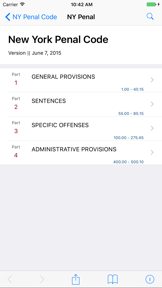
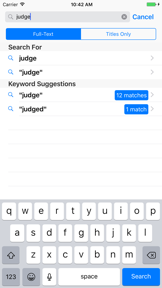
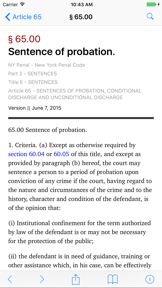


LawStack is a mobile legal reference library providing offline access to New York penal codes for attorneys and law students.
Product velocity
Active
Daily rank 🇺🇸
—
Reference
Sentiment
4.4
18 reviews
Nemesis

Кодекси: Дія КУпАП Конституція
The App DNA
What makes this app unique?
Users hire this app for reliable, offline access to statutes in environments where internet connectivity is restricted or unavailable.
For Legal professionals, attorneys, and law students requiring portable, offline access to statutes.
What does it look like?
Key features
Full legal library content stored locally on the device for access without internet connectivity.
Search engine for locating specific statutes, regulations, and rules within the downloaded legal database.
User-defined markers and annotations saved to specific legal sections for quick retrieval.
In-app purchase system to unlock updated versions of specific legal codes.
How much does it cost?
Freemium model uses free base content to drive installs, gating current legal codes behind pro-tier subscriptions.
Velocity
Active developmentShow more...
5 versions in history. Development pace: active.
Who built it?
Tekk Innovations
13+ apps tracked · Reference
 LawStack: CFR,USC,Statutes,Law
 FAR/AIM - FAA Pilot Reference
 Federal Rules of Civil Procedure (LawStack's FRCP)
 T-Charts (Pros and Cons)
 Federal Rules of Evidence (LawStack's FRE)
 FRAP by LawStack
 Manual of Patent Examining Proc. (LawStack MPEP)
 18 USC - Crimes and Criminal Procedure (LawStack)
 38 CFR - Pensions, Bonuses, and Veterans (LawStack
 1 USC by LawStack
 5 USC - Gov't Orgs and Employees (LawStack Series)
 49 CFR - Transportation (LawStack Series)
User Sentiment
What do users think recently?
The recent review mood reads thrilled. Users appreciate comprehensive access to legal statutes provides high utility for daily professional practice and frequent content updates ensure legal information remains accurate and relevant for users.
How are ratings & reviews evolving?
What users say, by theme
- Comprehensive access to legal statutes provides high utility for daily professional practice
- Frequent content updates ensure legal information remains accurate and relevant for users
- Limited depth of information fails to meet expectations for specific legal research needs
7 of 7 recent reviews analyzed · limited sample · Thrilled overall
Read the full review analysisCompetition
Competitive landscape for New York Penal Code (2017 LawStack NY Series)
How's the Reference market?
LawStack maintains a stable reference presence, though its 2017-era base library creates a reliability gap compared to modern, high-velocity competitors.
Read the market outlookThe rivals identified
By Dmytrii Sinko
This app serves the exact same job-to-be-done as this app: providing offline, searchable access to specific national legal codes.
- Provides a highly localized legal database that directly addresses the specific regulatory needs of Ukrainian citizens.
- Maintains a significantly higher release velocity to ensure legal code accuracy compared to this app's 2017-era base.
Unlock the deeper market read.
Access the full report for freeThe Analyst's Read
Key takeaways for New York Penal Code (2017 LawStack NY Series)
Where is it heading?
The legal reference market is consolidating around high-velocity, frequently updated databases that render static, legacy libraries obsolete. LawStack remains stable due to its offline utility, but it is exposed to churn if it fails to modernize its update cadence.
- The 2017-era base library creates an accuracy liability that high-velocity competitors exploit to erode the professional user base.
- Offline-first architecture remains a strong retention lever for legal professionals working in courtrooms with limited connectivity.
The SWOT
- Offline-first architecture enables courtroom utility
- Personalized annotation system increases user switching costs
- B2B partnerships with law firms for bulk licensing
- Integration of audio-guided reading plans
Next best moves
Audit legal database currency because 2017-era base creates accuracy risk → reduce churn to high-velocity competitors
+ 1 more prioritized moveThe counter-intuitive read
The app's reliance on a 2017-era base is a feature, not a bug…
Read the full takeFeature gaps
Real-time statute synchronization (available in Кодекси: Дія KУпАП but absent here) +1
Since the last report: The app introduced a Pro subscription tier to monetize updated content while facing increased competitive pressure regarding the age of its base legal library.
Bottom line
LawStack provides essential offline utility, but its reliance on outdated statutes threatens its professional standing, so the PM must prioritize database currency to prevent churn to high-velocity rivals.
Unlock 2 critical frictions, 2 market threats, 1 more prioritized move and the analyst’s take.
Access the full report for freeReport last updated