


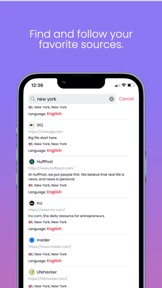


Newsreadeck is an ad-free news aggregation app for iOS and Android that provides on-device AI summaries and distraction-free reading.
Product velocity
Intense
Daily rank 🇺🇸
—
News
Sentiment
4.2
35 reviews
Nemesis

Feedly - Smarter News Reader
The App DNA
What makes this app unique?
Users hire Newsreadeck to manage information overload from global sources without the privacy trade-offs or algorithmic noise inherent in major news platforms.
For Information-heavy readers and professionals who consume content from diverse global sources and require tools to manage information overload.
What does it look like?
Key features
Generates key points from articles locally on the device without cloud processing
Converts any article into audio playback using built-in text-to-speech
Synchronizes feeds, saved articles, and reading preferences across iOS devices via account login
How much does it cost?
The app operates on a 100% free model with no advertising or subscription tiers, prioritizing user growth and data-driven engagement.
Velocity
Intense developmentShow more...
5 versions in history. Development pace: intense.
Who built it?
Marcelo Perretta
6 apps tracked · News
 Store Assets Generator
 ROSicleta, tu andar en Rosario
 Rosario en Bici
 La Boing Unofficial
 Zoundit: Live Radio FM & Music
User Sentiment
What do users think recently?
The recent review mood reads frustrated.
How are ratings & reviews evolving?
What users say, by theme
- Content refresh failure prevents new articles from appearing in the main feed
3 of 3 recent reviews analyzed · limited sample
Read the full review analysisUnlock 1 more frustration theme, each backed by review evidence.
Access the full report for freeCompetition
Competitive landscape for Newsreadeck: AI News Reader
How's the News market?
Newsreadeck sits #58 Grossing in the AE category, though recent rank volatility (↓21) indicates retention pressure. The lack of monetization tiers contrasts with the high-end publisher-specific apps like The Economist, positioning it as a pure utility play.
Read the market outlookThe rivals identified
By Feedly Inc.
Feedly is the dominant incumbent in the RSS-based news aggregation space, mirroring Newsreadeck's core value proposition of user-curated source control.
- Offers advanced AI-driven 'Leo' assistant to filter noise and prioritize specific topics across thousands of feeds
- Provides robust cross-platform synchronization and deep integration with third-party productivity tools like Slack and Notion
- Maintains a mature ecosystem of power-user features including keyword muting and board-based content organization


Unlock the head-to-head verdict: where this rival wins, and where it loses.
Access the full report for freeThe Analyst's Read
Key takeaways for Newsreadeck: AI News Reader
Where is it heading?
The news aggregation market is consolidating around high-velocity, AI-assisted products, leaving Newsreadeck exposed due to its current technical instability. Unless the team resolves the feed-refresh regressions immediately, the app will lose its foothold in the casual-reader segment to more reliable, algorithm-driven alternatives.
- Critical feed-refresh failures in the latest release prevent content updates, which directly erodes the daily active habit and drives negative sentiment.
- Recent rank volatility across international markets suggests that users are abandoning the app due to persistent functional regressions.
The SWOT
- On-device AI summarization ensures privacy-first utility
- Distraction-free reader view lowers cognitive load
- Cross-device sync increases user switching costs
- Education partnerships for B2B distribution
- Wearable integration for audio-first news consumption
- Niche productivity tool integrations
Next best moves
Rebuild feed-refresh logic because users report frozen content → restore daily active habit
+ 1 more prioritized moveThe counter-intuitive read
The app's lack of monetization is a strategic vulnerability…
Read the full takeFeature gaps
Advanced AI-driven filtering (available in Feedly but absent here) +2
Since the last report: The app's competitive position has declined due to critical technical regressions in feed-refreshing and navigation, despite the continued utility of its on-device AI summarization.
Bottom line
Newsreadeck provides a clean, ad-free reading experience, but the core feed-refresh failure prevents it from competing with established aggregators, so the PM must prioritize technical stability over new feature development.
Unlock 3 critical frictions, 3 market threats, 1 more prioritized move and the analyst’s take.
Access the full report for freeReport last updated