


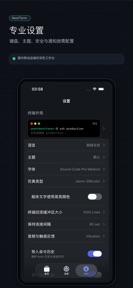



NextTerm is an SSH and SFTP client for iOS, designed for developers and system administrators managing remote servers.
The App DNA
What makes this app unique?
The app removes the friction of desktop-bound server management by providing a mobile-native interface for terminal access and file transfers.
For Developers and system administrators managing remote servers from mobile devices.
What does it look like?
Key features
Terminal interface with custom keyboard controls, serving as a core retention lever for system administrators.
Integrated file browsing and transfer, functioning as a core retention lever.
Pre-configured command templates gated by the Pro tier, acting as a paid-conversion lever.
Secure port forwarding configuration, serving as a premium-tier gate.
How much does it cost?
The freemium model gates advanced workflow automation tools behind a Pro upgrade to drive paid conversion.
Velocity
Maintenance developmentopaqueShow more...
NextTerm - SSH & SFTP Client currently operates on a maintenance cadence, with only one release shipped in the last 55 days. The development trend is currently stagnant, as the single available version lacks descriptive release notes to indicate active feature development. Given the lack of recent updates or roadmap signals, the app appears to be in a long-term support phase focused on stability rather than new functionality.
Who built it?
lecoo
4 apps tracked · Utilities
 番茄时钟专业版
 Dashcam - Smart Car Recorder
 IPTV Player: M3U & Live TV
User Sentiment
What do users think recently?
How are ratings & reviews evolving?
Not enough recent reviews to extract reliable themes yet.
Read the full review analysisCompetition
Competitive landscape for NextTerm - SSH & SFTP Client
How's the Utilities market?
NextTerm occupies the niche Utilities space for mobile server management, relying on a freemium model to compete with established terminal clients.
Read the market outlookThe rivals identified
Unlock the deeper market read.
Access the full report for freeThe Analyst's Read
Key takeaways for NextTerm - SSH & SFTP Client
Where is it heading?
The mobile SSH market is consolidating around tools that offer the most reliable automation for power users. NextTerm's focus on Pro-tier workflow tools positions it to capture this segment, provided the team maintains high stability standards to retain user trust.
- The current maintenance-only release cycle suggests a focus on stability over rapid feature expansion, which aligns with the needs of server-management tools.
- Gating workflow automation behind the Pro tier creates a clear path for revenue growth as the user base matures into power-user workflows.
The SWOT
- Keychain-based credential storage provides a security-focused barrier for server access
- Local network discovery reduces friction for internal infrastructure management
- Pro-tier snippet library offers a clear path to capture power users from less-automated clients
Next best moves
Ship cloud-sync for snippets because the current local-only storage limits multi-device utility → increase Pro-tier retention
+ 1 more prioritized moveThe counter-intuitive read
The lack of frequent updates is not a…
Read the full takeSince the last report: The product roadmap has shifted to prioritize Pro-tier automation, specifically cloud-sync for snippets, to address power-user friction. This strategic pivot acknowledges the competitive pressure from established SSH clients with longer update histories.
Bottom line
NextTerm must prioritize Pro-tier automation to differentiate from legacy clients, as the current maintenance-only cadence risks losing the power-user segment. Investing in cloud-sync for snippets would unlock higher Pro-tier value and address the primary friction point for multi-device administrators.
Unlock 2 critical frictions, 1 market threat, 1 more prioritized move and the analyst’s take.
Access the full report for freeFAQ
Is NextTerm suitable for professional server management?
What features are included in the Pro tier?
Does NextTerm route my server traffic through external services?
What are the alternatives for SSH management on iOS?
Sources
- [1] App Store, source
Report last updated