


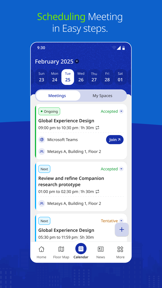


OpenBlue Companion is a mobile application for building occupants to manage workspace reservations and interact with IoT-enabled facility systems.
The App DNA
What makes this app unique?
Users hire the app to coordinate hybrid work schedules and control their physical environment, while managers use it to optimize space utilization through enterprise contracts.
For Building occupants and facility managers seeking to optimize workspace productivity and hybrid work coordination.
What does it look like?
Key features
Enables workspace reservations to support hybrid work planning, acting as a core retention loop for office occupants.
Automates building experiences, functioning as a B2B distribution barrier by embedding the app into facility management contracts.
How much does it cost?
The app follows a free-to-use model, likely bundled with enterprise facility management contracts to drive adoption.
Velocity
Steady developmentShow more...
Who built it?
Johnson Controls
13+ apps tracked · Productivity
 Simplex Foundation Series
 Johnson Controls Security Mngt
 Lux Products
 GoTemp Pro
 Xaap
Xaap Greenlite Thermostat
 GLAS by JCI
 YORK Chiller Access Manager
 FAN-410 Installation Reference
 Johnson Controls CWa
 OpenBlue DataSource
 SafeLINC
User Sentiment
What do users think recently?
How are ratings & reviews evolving?
Not enough recent reviews to extract reliable themes yet.
Read the full review analysisCompetition
Competitive landscape for OpenBlue Companion
How's the Productivity market?
OpenBlue Companion occupies a niche in the Productivity category, focusing on physical building infrastructure rather than general labor management. Its reliance on enterprise-bundled distribution limits its visibility in public app store charts compared to standalone productivity tools.
Read the market outlookThe rivals identified

By Work Market, Inc.
WorkMarket competes for the same enterprise-grade workforce management and labor coordination budget, focusing on the operational efficiency of mobile workforces.
- Automated compliance guardrails ensure regulatory adherence, a critical gap in OpenBlue's current occupant-focused feature set.
- Massive labor cloud ecosystem provides immediate access to vetted talent, far exceeding OpenBlue's internal building management scope.
- Deep integration with ADP payroll systems creates a sticky financial dependency that OpenBlue currently lacks.




Unlock the head-to-head verdict: where this rival wins, and where it loses.
Access the full report for freeThe Analyst's Read
Key takeaways for OpenBlue Companion
Where is it heading?
The market for smart building tools is shifting toward integrated collaboration, leaving utility-only apps like OpenBlue exposed to digital-first competitors. The app must evolve beyond simple space booking to maintain relevance as hybrid work strategies mature.
- The current focus on IoT integration maintains utility for facility managers but fails to address the growing demand for collaborative workspace features.
- The lack of predictive scheduling capabilities forces users to rely on manual booking, which increases friction and reduces the overall productivity value.
The SWOT
- IoT-sensor integration enables real-time occupant environment control
- Enterprise-bundled distribution model secures immediate access to large-scale facility management contracts
- Expansion into wearable integration could provide a new data-collection layer for building health
Next best moves
Ship predictive scheduling features because manual booking is a top competitive gap against farmerswife → increase occupant retention
+ 1 more prioritized moveThe counter-intuitive read
The app's reliance on enterprise-bundled distribution is its greatest strength…
Read the full takeFeature gaps
Predictive scheduling (available in farmerswife but absent here) +1
Since the last report: The app is pivoting from a utility-only occupant tool to a more integrated workspace platform to counter competition from collaboration-first software.
Bottom line
OpenBlue Companion holds a defensible position through its integration with physical building infrastructure, but it lacks the collaborative depth to compete with modern digital workspace tools, so the PM should prioritize predictive scheduling to increase occupant stickiness.
Unlock 2 critical frictions, 1 market threat, 1 more prioritized move and the analyst’s take.
Access the full report for freeSources
- [1] App Store, source
Report last updated