


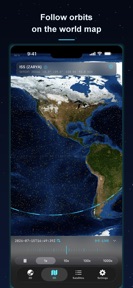


Orbit Viewer is an educational satellite tracking tool for iOS that visualizes 16,000+ active satellites on a 3D globe and 2D map.
The App DNA
What makes this app unique?
The app removes the connectivity dependency of cloud-reliant trackers by bundling TLE data for offline use, serving users who track satellites in remote locations.
For Space enthusiasts, ISS watchers, educators, and students interested in real-time satellite tracking.
What does it look like?
Key features
Renders 16,000+ active satellites with inertial rotation and zoom gestures.
Bundled TLE data allows satellite tracking without an active internet connection.
Scrub through orbital positions from 1x to 1000x speed using a jog dial interface.
How much does it cost?
Monetization is limited to a single conversion point for ad removal, lacking recurring revenue streams or advanced feature gating.
Velocity
Maintenance developmentinternationalizationUX improvementsShow more...
Orbit Viewer: Live Satellites operates on a maintenance cadence, with only one version released in the observed window. The latest update introduced support for four additional languages and addressed several functional issues, including 3D rotation and time synchronization. Development appears focused on stability and internationalization rather than rapid feature iteration. Given the current release frequency, the app remains in a maintenance state.
Who built it?
User Sentiment
What do users think recently?
How are ratings & reviews evolving?
Not enough recent reviews to extract reliable themes yet.
Read the full review analysisCompetition
Competitive landscape for Orbit Viewer: Live Satellites
How's the Education market?
Orbit Viewer operates in the Education category, differentiating via offline-first TLE data access. The reliance on a one-time purchase model suggests a focus on utility-first acquisition rather than high-frequency monetization.
Read the market outlookThe rivals identified
Unlock the deeper market read.
Access the full report for freeThe Analyst's Read
Key takeaways for Orbit Viewer: Live Satellites
Where is it heading?
The satellite tracking market is consolidating around utility-focused tools that provide actionable alerts rather than passive visualization. Orbit Viewer remains stable but exposed, as its current manual interface risks losing users to rivals that offer automated pass notifications.
- The latest release focuses on localization and navigation refinements, confirming a maintenance-mode cadence rather than aggressive feature expansion.
- Offline-first data support provides a distinct utility advantage that reduces churn in low-connectivity environments.
The SWOT
- Offline-first TLE data bundling enables tracking in remote locations without cellular connectivity.
- Integrating push notifications for specific satellite passes would drive daily active usage.
Next best moves
Ship push notifications for satellite passes because the current manual-scrubbing interface limits retention to high-intent sessions → increase daily active usage
The counter-intuitive read
The offline-first design is a retention lever in…
Read the full takeSince the last report: Orbit Viewer pivoted its development priority from UI refinements to the integration of automated push notifications for satellite passes. This shift addresses a identified retention gap caused by the app's manual-only interaction model.
Bottom line
Orbit Viewer's offline-first utility provides a defensible niche, but the current manual-scrubbing interface limits retention. Shifting to an alert-based utility would unlock daily engagement and justify a more robust monetization strategy.
Unlock 1 critical friction, 1 market threat and the analyst’s take.
Access the full report for freeSources
- [1] App Store, source
Report last updated