


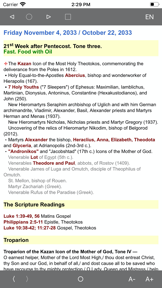
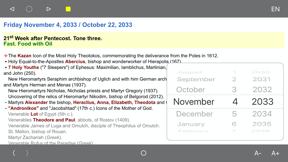
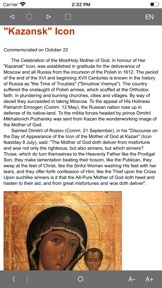
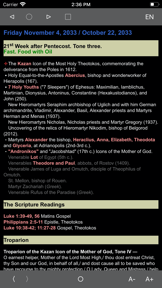
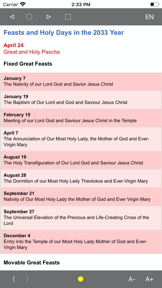
Orthodox Calendar is a liturgical utility for Orthodox Christians that provides daily scripture, saint lives, and Julian calendar dates on iOS and Android.
The App DNA
What makes this app unique?
It replaces manual calendar tracking and physical book references with a single, bilingual digital interface that supports daily prayer habits.
For Members of the Orthodox Christian faith who follow the Julian calendar and require daily access to liturgical texts.
What does it look like?
Key features
Displays liturgical dates and feasts based on the Julian system, establishing brand authority for traditionalist practitioners.
Provides access to lives of saints, icons, and prayers, compounding daily session frequency.
Interface and content available in English and Russian, expanding the addressable market.
How much does it cost?
The app operates as a non-monetized utility, likely supported by parish community contributions rather than commercial revenue.
Velocity
Dormant developmentperformanceShow more...
Orthodox Calendar has been inactive for 772 days, indicating a complete cessation of development. The latest release was a minor update focused on platform requirements, and there have been no feature additions or maintenance patches since. The project shows no signs of active support or ongoing engagement.
Who built it?

User Sentiment
What do users think recently?
Review voice lately leans thrilled. Users appreciate comprehensive daily content including scripture readings and saint biographies provides a complete spiritual resource for daily prayer and bilingual support for english and russian allows users to switch languages and compare texts during daily study, but report lack of support for the revised julian calendar forces users to manually adjust dates for their parish.
How are ratings & reviews evolving?
What users say, by theme
- Comprehensive daily content including scripture readings and saint biographies provides a complete spiritual resource for daily prayer
- Bilingual support for English and Russian allows users to switch languages and compare texts during daily study
- The inclusion of Saint Theophan the Recluse daily thoughts adds significant depth to the existing liturgical calendar
- Lack of support for the Revised Julian calendar forces users to manually adjust dates for their parish
99 of 99 recent reviews analyzed · high confidence · Thrilled overall
Read the full review analysisUnlock 2 more frustration themes and 3 user requests, each backed by review evidence.
Access the full report for freeCompetition
Competitive landscape for Orthodox Calendar
How's the Lifestyle market?
Orthodox Calendar occupies a specialized niche in the Lifestyle category, maintaining a 4.8 rating on Android and 4.79 on iOS. Its authority rests on the Julian calendar integration, which serves as a primary utility for traditionalist users.
Read the market outlookThe rivals identified
Unlock the deeper market read.
Access the full report for freeThe Analyst's Read
Key takeaways for Orthodox Calendar
Where is it heading?
Orthodox Calendar remains a stable utility for its target audience, but its reliance on server-side connectivity leaves it vulnerable to churn. Addressing technical stability and calendar customization is essential to maintaining its position as the primary digital tool for the faithful.
- Server-side bandwidth errors disrupt the daily prayer habit, which creates a persistent barrier to reliable daily use.
- The inclusion of patristic commentary adds depth to the liturgical calendar, reinforcing the app's value as a daily spiritual resource.
The SWOT
- Julian calendar integration creates a defensible barrier for traditionalist practitioners.
- Bilingual English-Russian support expands the addressable market to international households.
- Comprehensive daily content library drives high daily session frequency.
- Dark mode implementation would reduce eye strain during early morning or late night use.
- Search functionality for saints and feast days would reduce manual navigation friction.
- Annual overview view would assist users in planning upcoming feast and fast days.
Next best moves
Migrate content to local storage because connectivity dependency is the top-cited barrier to reliable daily use → increase session reliability
+ 1 more prioritized moveThe counter-intuitive read
The app's lack of monetization is its strongest retention lever…
Read the full takeBottom line
Resolving server-side connectivity issues would stabilize the daily prayer habit and reduce the churn risk currently driven by bandwidth errors. Prioritizing offline access would unlock higher retention among users in low-connectivity environments.
Unlock 3 critical frictions, 2 market threats, 1 more prioritized move and the analyst’s take.
Access the full report for freeSources
- [1] Play Store listing, source
Report last updated