


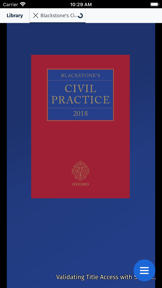


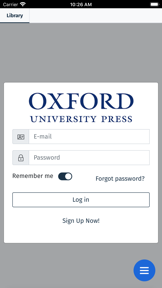
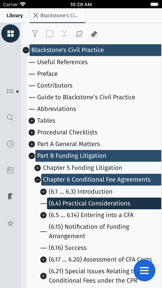

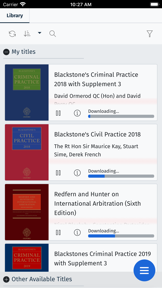

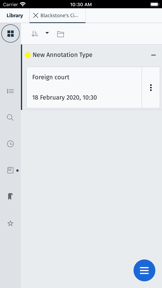
OUP - LawReader is a reference app providing legal professionals and students with access to Oxford University Press publications on iOS.
The App DNA
What makes this app unique?
Users hire LawReader to access authoritative legal texts for deep research, but the physical-book-dependent access model forces a high-friction entry that modern, digital-first competitors avoid.
For Legal professionals, students, and newly qualified lawyers.
What does it look like?
Key features
Search across multiple publications simultaneously.
Open multiple publications in separate tabs.
Full-text search with boolean operators.
How much does it cost?
Monetization is coupled to physical book sales, creating a high barrier to entry for digital-only users.
Velocity
Maintenance developmentperformanceUX improvementsShow more...
The app has released only one update in the last six months, resulting in a cadence of approximately 0.04 releases per week. This velocity falls into the maintenance tier, as there is no evidence of new feature development or live operations. The latest release focused exclusively on technical refinements, specifically media panel handling and offline status logic. Development appears to be in a long-term maintenance state with no recent major feature milestones.
Who built it?

User Sentiment
What do users think recently?
How are ratings & reviews evolving?
Not enough recent reviews to extract reliable themes yet.
Read the full review analysisCompetition
Competitive landscape for OUP - LawReader
How's the Reference market?
LawReader occupies a niche within the Reference category, targeting legal professionals who require authoritative content. The reliance on physical book sales for digital access limits the app's ability to compete with subscription-based, digital-first reference tools.
The rivals identified

By DEEP FLOW SOFTWARE SERVICES
Sparkle competes directly by offering a high-frequency, mobile-first consumption model that challenges LawReader’s traditional, document-heavy reference approach.
- Offers dual-format consumption, allowing users to switch between reading and listening to content seamlessly.
- Utilizes a micro-learning framework that encourages daily engagement, unlike LawReader’s static, long-form reference library.
- Maintains a high release cadence, signaling a more aggressive product iteration cycle than LawReader.
 Children's Poems - Kids' Poetry & Nursery Rhymes!Contender
 The Divine ComedyContender
 Tolstoy AppContender
 ObjektAI: Read, Study, GrowContender
Unlock the head-to-head verdict: where this rival wins, and where it loses.
Access the full report for freeThe Analyst's Read
Key takeaways for OUP - LawReader
Where is it heading?
The legal reference market is shifting toward mobile-first, high-frequency consumption, which exposes LawReader's static, document-heavy model to disruption from AI-driven rivals. Unless the app transitions to a digital-first access model, it risks losing the next generation of legal professionals to more agile, study-oriented platforms.
- The lack of a digital-only subscription model limits growth in a market increasingly dominated by low-friction, subscription-based competitors.
- The authoritative OUP content library remains a high-value asset that generalist competitors cannot replicate, providing a stable core for professional research.
The SWOT
- Authoritative OUP content library functions as a high-barrier-to-entry moat against generalist educational apps.
- Tabbed interface enables complex multi-publication research workflows that generalist readers cannot replicate.
- Integration of audio-summary features could recapture users migrating to Sparkle for quick knowledge acquisition.
- AI-powered quiz generation could convert the static library into an active study tool.
Next best moves
Ship standalone digital subscription because the current physical-book-dependent model limits digital-only user acquisition → increase user funnel.
+ 1 more prioritized moveThe counter-intuitive read
The reliance on physical book sales is not just a legacy constraint…
Read the full takeFeature gaps
AI-powered quiz generation (available in ObjektAI but missing here) +1
Since the last report: The competitive focus moved from speed-reading tools to AI-driven study and audio-summary platforms, prompting a shift in PM priorities toward digital-only subscription models.
Bottom line
LawReader maintains a strong position for deep legal research through authoritative content, but its physical-book-dependent monetization model limits its reach, so the PM should prioritize a standalone digital subscription to capture the growing segment of mobile-first, digital-only legal professionals.
Unlock 2 critical frictions, 2 market threats, 1 more prioritized move and the analyst’s take.
Access the full report for freeSources
- [1] App Store listing, source
Report last updated