


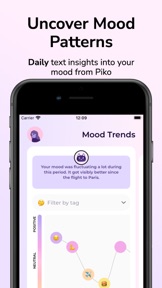


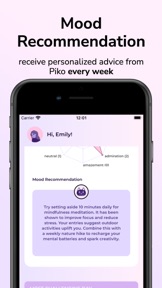
Piko AI is a lifestyle journaling app for iOS and Android that uses AI to tag and analyze daily mood swings.
The App DNA
What makes this app unique?
Users hire Piko AI to transform the chore of emotional logging into a supportive, gamified habit that provides actionable insights into their mental health.
For Individuals seeking mental health support, emotional regulation, and self-improvement through structured journaling.
What does it look like?
Key features
Automated identification of feelings and events to reduce manual input effort.
Graphic representation of recurring life themes to highlight emotional patterns.
Interpretation of emotional tones to identify positive and negative life events, gating advanced insights to drive subscription conversion.
How much does it cost?
Freemium model gates advanced AI-driven emotional insights to convert engaged daily users into paid subscribers.
Velocity
Dormant developmentopaqueShow more...
The development momentum for Piko AI is classified as zombie status. The last recorded release occurred on August 22, 2024, and there have been no updates for over 17 months. Given the lack of activity across both iOS and Android platforms, the app appears to be in a state of abandonment. No new features, bug fixes, or live operations have been deployed in the recent window.
Who built it?
User Sentiment
What do users think recently?
The recent review mood reads excited. Users appreciate customizable mood tags and ai-driven reflection insights encourage consistent daily journaling habits and visual design and cat-themed interface elements create a welcoming space for emotional tracking.
How are ratings & reviews evolving?
What users say, by theme
- Customizable mood tags and AI-driven reflection insights encourage consistent daily journaling habits
- Visual design and cat-themed interface elements create a welcoming space for emotional tracking
- Technical instability including application crashes during startup and custom profile picture uploads
44 of 44 recent reviews analyzed · high confidence · Excited overall
Read the full review analysisUnlock 1 more frustration theme and 1 user request, each backed by review evidence.
Access the full report for freeCompetition
Competitive landscape for Piko AI: Mood Tracker Journal
How's the Lifestyle market?
Piko AI maintains a 4.76 rating on iOS with 100 reviews, positioning itself as a high-satisfaction niche player in the Lifestyle category. The gap between its interactive AI features and the lack of purchase restoration suggests a focus on acquisition over long-term subscription stability.
Read the market outlookThe rivals identified

By Kyungmoo Min
Emolog is the primary nemesis due to its massive user base and direct overlap in mood-tracking functionality, forcing Piko AI to compete for the same emotional-discovery audience.
- Emolog offers robust private diary encryption, a critical trust factor for sensitive mental health data.
- Animated emoji logging provides a faster, more visual entry experience than Piko's AI-heavy text approach.
- Established community statistics sharing creates a social network effect that Piko currently lacks.
 Holoholo: Daily MemoriesContender
 Emoji DiaryContender
 Moment Diary (journal)Contender
 Rond: Travel Journal & DiaryContender
Unlock the head-to-head verdict: where this rival wins, and where it loses.
Access the full report for freeThe Analyst's Read
Key takeaways for Piko AI: Mood Tracker Journal
Where is it heading?
The mood-tracking category is consolidating around apps that offer both deep analytical insights and high-frequency logging flexibility. Piko AI is currently exposed because its technical instability prevents it from capitalizing on its strong aesthetic appeal, so the PM must stabilize the core experience to prevent churn to more mature rivals like Emolog.
- Technical instability (startup crashes) erodes the daily active habit, which compounds the rating drag already visible on Android.
- The latest update maintains high engagement through AI-driven reflection summaries, which continue to drive positive user sentiment.
The SWOT
- Gamified cat-themed interface lowers daily journaling friction
- AI-powered tagging reduces manual entry effort for neurodivergent users
- Sentiment analysis provides unique, actionable emotional insights
- Expand into B2B mental health partnerships using the existing AI-tagging library
- Implement multi-entry support to capture granular emotional data
Next best moves
Audit purchase restoration logic because users report inability to restore lifetime memberships → reduce churn
+ 1 more prioritized moveThe counter-intuitive read
The app's reliance on a 'cozy' cat-themed interface…
Read the full takeFeature gaps
Private diary encryption (available in Emolog but missing here) +1
Since the last report: The app's development focus has shifted from UI-centric updates to addressing critical monetization and functional gaps, specifically purchase restoration and multi-entry logging.
Bottom line
Pink Piko succeeds by gamifying emotional discovery, but technical instability and purchase-restoration failures threaten to cap its growth, so the team must prioritize stability and multi-entry flexibility over new AI features to protect the core user base.
Unlock 3 critical frictions, 2 market threats, 1 more prioritized move and the analyst’s take.
Access the full report for freeSources
Report last updated