



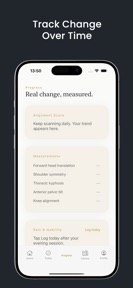


Pillar - Spinal Health is a posture-correction app for professionals that uses computer vision to generate personalized daily mobility protocols on iOS.
The App DNA
What makes this app unique?
Users want to replace generic posture advice with measurable, data-driven feedback on their specific spinal imbalances to reduce chronic discomfort.
For Professionals with chronic back, neck, or shoulder discomfort seeking a self-managed, data-driven approach to posture correction.
What does it look like?
Key features
30-second camera-based assessment measuring forward head position, shoulder symmetry, and pelvic tilt.
Daily 14-minute exercise sessions generated from individual scan data.
Visual representation of spinal alignment with labeled issues based on scan data.
How much does it cost?
Subscription model gated by a 3-day trial, with pricing determined at the point of purchase.
Velocity
Dormant developmentopaqueShow more...
Pillar - Spinal Health has seen no development activity for 145 days. With only a single version release in the observed window, the app currently exhibits no signs of active maintenance or feature updates. The lack of subsequent releases suggests the project is currently inactive.
Who built it?
Sirca
4 apps tracked · Health & Fitness
 Omni - Global Intelligence
 Intermittent - Fasting Timer
 Jaw - Jawline Training
User Sentiment
What do users think recently?
How are ratings & reviews evolving?
Not enough recent reviews to extract reliable themes yet.
Read the full review analysisCompetition
Competitive landscape for Pillar - Spinal Health
How's the Health & Fitness market?
Pillar - Spinal Health occupies a niche within the Health & Fitness category by focusing on computer vision-based spinal tracking. The absence of updates for 145 days suggests a static market position that risks losing ground to more active competitors.
Read the market outlookThe rivals identified
Unlock the deeper market read.
Access the full report for freeThe Analyst's Read
Key takeaways for Pillar - Spinal Health
Where is it heading?
The posture-correction market is shifting toward integrated health ecosystems, leaving standalone utilities like Pillar - Spinal Health vulnerable. Without a consistent release cadence, the app risks becoming a static tool that fails to retain users who expect ongoing protocol updates and feature expansion.
- The 145-day update gap indicates a maintenance-only posture, which limits the ability to respond to OS changes or user feedback.
- The computer vision-based scan provides a unique value proposition that remains relevant for users seeking self-managed spinal health solutions.
The SWOT
- Computer vision scan creates daily retention loop
- 3D modeling provides tangible progress feedback
- Personalized protocols differentiate from generic libraries
- Wearable platform integration for activity logging
- Localized content for high-ARPU international markets
Next best moves
Audit the core scan logic because the 145-day update gap risks technical decay on newer OS versions → maintain baseline stability.
+ 1 more prioritized moveThe counter-intuitive read
The lack of updates is not necessarily a failure…
Read the full takeBottom line
Pillar - Spinal Health relies on the novelty of its computer vision scan to drive initial adoption. The lack of updates over the last five months creates a retention risk: the platform must prove its long-term efficacy to justify the subscription cost before the user base churns.
Unlock 2 critical frictions, 2 market threats, 1 more prioritized move and the analyst’s take.
Access the full report for freeSources
- [1] App Store listing, source
Report last updated