


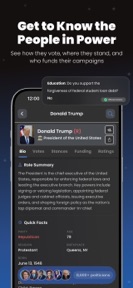


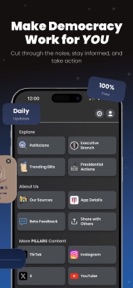
PILLARS is an education app that provides plain-English summaries of legislative bills, politician profiles, and election data on iOS and Android.
The App DNA
What makes this app unique?
It removes the cognitive cost of navigating dense government records, allowing users to track political impacts without needing legal expertise.
For Civically engaged individuals who find traditional political news overwhelming and require simplified, factual summaries of government actions.
What does it look like?
Key features
Plain-English translations of legislative text with cost estimates from the Congressional Budget Office.
Aggregated voting records, campaign donors, and interest group ratings for elected officials.
User-defined list of politicians and bills with push notifications for status changes.
How much does it cost?
PILLARS operates as a free utility, focusing on user acquisition and brand authority rather than immediate monetization.
Velocity
Maintenance developmentUX improvementssocial featuresShow more...
The app currently operates at a maintenance cadence, with only one release shipped in the last 74 days. Development is focused on UX improvements and feature refinements, such as the recent redesign of bill pages and the introduction of a watchlist. Given the 74-day gap since the last update, the development cycle is currently slow and lacks a recurring live-ops or high-frequency release pattern.
Who built it?
User Sentiment
What do users think recently?
The recent review mood reads thrilled. Users appreciate plain english summaries of complex legislative bills help voters understand political impacts without needing legal expertise and the watchlist feature provides a centralized hub for tracking specific politicians and bills with timely notifications.
How are ratings & reviews evolving?
What users say, by theme
- Plain English summaries of complex legislative bills help voters understand political impacts without needing legal expertise
- The watchlist feature provides a centralized hub for tracking specific politicians and bills with timely notifications
- Horizontal scrolling menus fail to respond to touch input, preventing access to specific navigation features
8 of 8 recent reviews analyzed · limited sample · Thrilled overall
Read the full review analysisUnlock 1 more frustration theme and 1 user request, each backed by review evidence.
Access the full report for freeCompetition
Competitive landscape for PILLARS - Simplifying Politics
How's the Education market?
PILLARS operates in the education space as a transparency-first utility. The current lack of monetization signals a focus on user acquisition over revenue, differentiating the app from news aggregators that rely on ad-supported models.
Read the market outlookThe rivals identified
Unlock the deeper market read.
Access the full report for freeThe Analyst's Read
Key takeaways for PILLARS - Simplifying Politics
Where is it heading?
Users report: The political transparency market is consolidating around utilities that offer simplified, factual data. PILLARS is well-positioned to capture this segment if it can resolve local-search friction and expand its data depth to include judicial records.
- The latest release added a personalized watchlist, which provides a centralized hub for tracking political interests and increases daily active usage.
- Navigation bugs were addressed in the latest update, suggesting the development team is responsive to user feedback regarding core usability.
The SWOT
- Plain-English legislative translations function as a primary utility for political literacy.
- Granular campaign finance data provides a transparency-based differentiator against general news aggregators.
- Watchlist notifications create a recurring engagement loop for tracking legislative status changes.
- Automated geolocation-based representative lookup would eliminate manual search friction.
- Expanding data coverage to include Supreme Court voting history would address top-requested feature gaps.
Next best moves
Automate representative lookup using device location because manual entry is a top-reported friction point → increase local engagement.
+ 2 more prioritized movesThe counter-intuitive read
The lack of monetization is not a weakness but a strategic moat…
Read the full takeBottom line
Automating local representative discovery would remove the primary friction point currently limiting local engagement. Prioritizing this over data-depth expansion would solidify the user base before scaling into more complex judicial records.
Unlock 3 critical frictions, 2 market threats, 2 more prioritized moves and the analyst’s take.
Access the full report for freeSources
- [1] App Store listing, source
Report last updated