


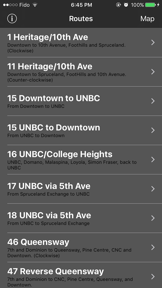
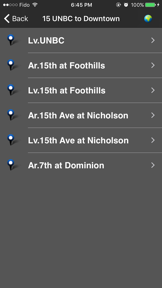

Prince George Transit is a mobile utility for local commuters in Prince George that provides digital access to bus schedules.
The App DNA
What makes this app unique?
The app removes the friction of relying on printed guides, which often leads to missed departures for daily commuters.
For Public transit commuters living in Prince George.
What does it look like?
Key features
Provides a mobile-based alternative to the traditional printed Riders' Guide, acting as a retention loop for daily commuters.
Assists users in identifying correct bus schedules to prevent missed departures, serving as the core utility gate.
How much does it cost?
The app operates on a free model, focusing on utility for local commuters without current monetization.
Velocity
Steady developmentShow more...
Who built it?
Huge Holdings
11 apps tracked · Travel
 Itripoley
 Winterland Scratchers
 Rummoli
 RichiScratcher
 Marble Tilt
 Bubbles in Space
 H3GE TV
 H3GE CONNECT
 Stockticker
 Poker Bingo Game
User Sentiment
What do users think recently?
The recent review mood reads thrilled.
How are ratings & reviews evolving?
Not enough recent reviews to extract reliable themes yet.
Read the full review analysisCompetition
Competitive landscape for Prince George Transit
How's the Travel market?
Prince George Transit holds a 5-star rating based on a single review, reflecting a niche, hyper-local utility position. The lack of recent updates (206 days) suggests a maintenance-only posture compared to active travel-guide rivals.
Read the market outlookThe rivals identified

By The National Trust
This app competes for the same local discovery and travel-planning audience by providing location-based utility and event discovery, directly challenging this app's goal of simplifying local transit and navigation.
- Offers robust offline content access, ensuring users remain informed even without reliable cellular data connectivity.
- Leverages a massive, established database of location-based search results that far exceeds local transit-only utility.
- Provides integrated event discovery features that turn a simple navigation tool into a comprehensive lifestyle companion.
 eGO BostonContender
 НЕАПОЛЬ Путеводитель и КартаContender
 Discover Durham, NCContender
 FLORENCE Travel Guide & MapContender
Unlock the head-to-head verdict: where this rival wins, and where it loses.
Access the full report for freeThe Analyst's Read
Key takeaways for Prince George Transit
Where is it heading?
Users report: The local transit market is shifting toward real-time, dynamic data, which Prince George Transit currently lacks. Without feature expansion, the app remains a static utility that is increasingly exposed to more agile, data-rich competitors.
- The 206-day update gap indicates a maintenance-only posture, which limits the ability to compete with dynamic navigation tools.
The SWOT
- Hyper-focused utility reduces cognitive load for daily commuters compared to broad travel apps.
- Integration of real-time bus location data would differentiate the app from static schedule-based rivals.
Next best moves
Ship offline schedule caching because the current connectivity dependency is a major friction point → increase daily utility
The counter-intuitive read
The app's simplicity is its primary defense against feature-heavy travel guides…
Read the full takeFeature gaps
Offline map functionality (available in FLORENCE Travel Guide & Map but absent here) +1
Since the last report: The product roadmap shifted from a focus on real-time data integration to offline schedule caching as the primary mechanism to reduce churn. The update gap increased from 189 to 206 days, confirming the maintenance-only trajectory.
Bottom line
Prince George Transit serves its core utility, but the lack of real-time data or offline support leaves it vulnerable to broader travel apps. Prioritizing offline caching would secure the daily commuter base against more feature-rich competitors.
Unlock 1 critical friction, 1 market threat and the analyst’s take.
Access the full report for freeFAQ
Does Prince George Transit work without an internet connection?
Is Prince George Transit better than general travel apps?
Is Prince George Transit free to use?
Sources
- [1] App Store, source
Report last updated