


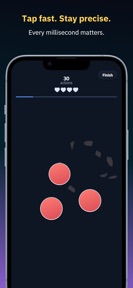


NeuroDash is a reflex and memory training game for iOS and Android, structured around short, data-focused sessions.
The App DNA
What makes this app unique?
The app removes the cognitive friction of complex menus, allowing users to immediately test reaction times and track progress against personal bests.
For Casual gamers interested in cognitive training, reflex testing, and tracking personal performance metrics.
What does it look like?
Key features
Ten distinct mini-games testing reaction time and pattern recognition.
Daily goal tracking and streak recovery system to monitor long-term progress.
Real-time tracking of reaction time in milliseconds, accuracy, and mistakes.
How much does it cost?
The app relies on Google AdMob for revenue, with no identified IAP or subscription gates, limiting monetization to ad-impression volume.
Velocity
Active developmentnew contentUX improvementsShow more...
NeuroDash maintains an active development pace, shipping two releases within the last 12 days. The latest version focuses on UX improvements and feature additions, specifically addressing streak management and visual polish. Development appears stable, with the team actively iterating on both core game mechanics and user-facing features. The current cadence suggests a consistent effort to refine the app experience through frequent, incremental updates.
Who built it?
User Sentiment
What do users think recently?
How are ratings & reviews evolving?
Not enough recent reviews to extract reliable themes yet.
Read the full review analysisCompetition
Competitive landscape for NeuroDash: Reaction Time Test
How's the Games market?
NeuroDash occupies a niche in the casual reflex-training space, relying on a minimalist, data-first approach to differentiate from more visually complex competitors. The current ad-only monetization model suggests a focus on broad reach rather than high-ARPU conversion, which may limit long-term sustainability as user acquisition costs rise.
Read the market outlookThe rivals identified
Unlock the deeper market read.
Access the full report for freeThe Analyst's Read
Key takeaways for NeuroDash: Reaction Time Test
Where is it heading?
The reflex-training market is consolidating around apps that offer either deep social competition or premium cognitive-training programs. NeuroDash remains positioned as a lightweight utility, which keeps development costs low but leaves the app vulnerable to larger competitors who can subsidize ad-free experiences.
- The bi-weekly release cadence shows active feature investment, which sustains the daily-habit loop for the core user base.
- The reliance on ad-only revenue creates a ceiling on growth, as the app cannot effectively fund user acquisition against larger competitors.
The SWOT
- Minimalist interface sustains session frequency
- Real-time millisecond tracking drives record-chasing
- Daily streak recovery creates retention habit
- Introduce Pro purchase to remove ads
- Expand memory-mode difficulty tiers
Next best moves
Introduce a one-time Pro purchase to remove ads because the current ad-only model limits ARPU → increase lifetime value
+ 1 more prioritized moveThe counter-intuitive read
The ad-only model is not a weakness but a deliberate retention lever…
Read the full takeSince the last report: The product strategy shifted from a passive ad-supported model to an active development plan for a one-time Pro purchase and social leaderboard integration. These changes prioritize increasing lifetime value and organic install velocity over the previous focus on minimalist feature maintenance.
Bottom line
NeuroDash maintains a clean, metric-focused experience that serves the reflex-training niche, but the reliance on ad-only revenue limits the ability to scale beyond casual interest. Shifting to a hybrid model would unlock higher ARPU from the core power users who currently chase records daily.
Unlock 3 critical frictions, 2 market threats, 1 more prioritized move and the analyst’s take.
Access the full report for freeFAQ
Is NeuroDash suitable for casual daily use?
How does NeuroDash compare to other brain training apps?
Does NeuroDash contain intrusive ads?
Are there alternatives to NeuroDash for reflex training?
Sources
- [1] App Store, source
Report last updated