


Shelter Aid
By Amit Kaushik


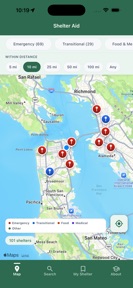


Shelter Aid is a utility app for iOS that helps users find nearby shelters using aggregated public data.
The App DNA
What makes this app unique?
Users hire Shelter Aid to quickly identify emergency resources in high-stress situations, but the current static data model forces them to perform secondary verification.
For Individuals, families, volunteers, and nonprofit teams seeking access to essential shelter information.
What does it look like?
Key features
Visualizes shelter locations on a map interface for geographic discovery.
Limits search results to a specific distance from the user current location.
Allows users to bookmark up to five shelter locations for quick access.
How much does it cost?
The app is distributed as a free utility with no visible monetization or in-app purchase gates.
Velocity
Maintenance developmentUX improvementsnew contentShow more...
Shelter Aid is currently in a maintenance phase, having released only one update in the last 108 days. The latest version focused on basic UX improvements, such as adding a radius filter and a saved shelters management screen. Development appears to be infrequent, with no evidence of live operations or recurring content updates. The current cadence of approximately 0.06 releases per week places the app firmly in the maintenance category.
Who built it?
User Sentiment
What do users think recently?
How are ratings & reviews evolving?
Not enough recent reviews to extract reliable themes yet.
Read the full review analysisCompetition
Competitive landscape for Shelter Aid
How's the Utilities market?
Shelter Aid maintains a niche presence in the Utilities category with a 5-star rating based on 5 reviews. The lack of recent feature updates suggests a maintenance-focused posture rather than active market share acquisition.
Read the market outlookThe rivals identified
Unlock the deeper market read.
Access the full report for freeThe Analyst's Read
Key takeaways for Shelter Aid
Where is it heading?
Users report: The market for emergency utility apps is shifting toward real-time, verified data, which leaves Shelter Aid's static model exposed to obsolescence. The PM must transition the app from a directory to a live-data platform to maintain relevance against more dynamic competitors.
- The 108-day update gap suggests a lack of active development, which increases the risk of data obsolescence in a utility-focused app.
- Current reliance on static, publicly available data limits the app's ability to provide real-time utility during emergencies, capping its growth potential.
The SWOT
- Public data aggregation model provides low-cost, broad geographic coverage.
- Minimalist interface reduces cognitive load for users in high-stress scenarios.
- Integration with local nonprofit APIs could provide real-time data verification.
- Community-driven reporting features could replace static data with live, user-verified updates.
Next best moves
Pivot to a community-verified data model because static listings fail to reflect real-time shelter capacity → increase user trust and retention.
+ 1 more prioritized moveThe counter-intuitive read
Shelter Aid's lack of monetization is a strategic liability…
Read the full takeSince the last report: The app remains in a maintenance state, but the analytical focus has shifted from internal feature limitations to the external threat of data obsolescence and the necessity of a community-verified data model.
Bottom line
Shelter Aid offers a functional directory for shelter discovery, but its reliance on static data limits its utility in emergency scenarios, so the PM should prioritize real-time data verification to prevent user churn during critical moments.
Unlock 2 critical frictions, 2 market threats, 1 more prioritized move and the analyst’s take.
Access the full report for freeSources
- [1] App Store
Report last updated