


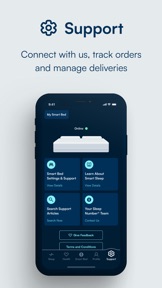
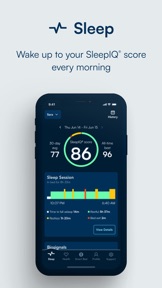

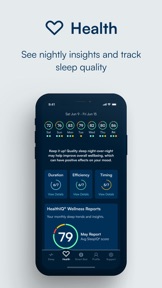

Sleep Number is a companion app for smart bed owners, providing biometric sleep tracking and automated bed firmness controls on iOS and Android.
The App DNA
What makes this app unique?
The app serves as the primary interface for hardware-based sleep adjustments, removing the need for manual firmness changes while providing health-trend visibility.
For Current owners of Sleep Number smart beds seeking to monitor sleep health and manage bed settings.
What does it look like?
Key features
Biosignal sensors trigger automatic firmness adjustments during sleep, creating high switching costs.
Scheduled temperature adjustments drive upsell to higher-tier mattress models.
Daily engagement loop increases app open frequency.
How much does it cost?
The app functions as a utility for existing hardware owners, focusing on retention and ecosystem-based commerce rather than subscription revenue.
Velocity
Maintenance developmentUX improvementsperformanceShow more...
The app ships at a maintenance cadence, averaging approximately one release every three weeks. Development is currently focused on incremental performance improvements and the addition of personalized sleep insights. The release history shows a stable, low-frequency pattern without evidence of a shift toward live-ops or high-velocity feature deployment. The latest release continues this trend of minor technical refinements.
Who built it?

User Sentiment
What do users think recently?
Fresh user feedback skews frustrated. Users appreciate core bed adjustment controls provide reliable firmness customization for users who avoid the sleep tracking features and the interface design is generally simple and easy to navigate for daily bed control tasks, but report forced consent for personal health data sharing prevents users from accessing basic bed control hardware features.
How are ratings & reviews evolving?
Weekly average review rating
What users say, by theme
- Core bed adjustment controls provide reliable firmness customization for users who avoid the sleep tracking features
- The interface design is generally simple and easy to navigate for daily bed control tasks
- Forced consent for personal health data sharing prevents users from accessing basic bed control hardware features
73 of 99 recent reviews analyzed · high confidence · Frustrated overall
Read the full review analysisUnlock 2 more frustration themes and 2 user requests, each backed by review evidence.
Access the full report for freeCompetition
Competitive landscape for Sleep Number
How's the Health & Fitness market?
Sleep Number operates as a proprietary utility for hardware owners, with a 4.54 rating on iOS and 4.25 on Android. The reliance on cloud connectivity for basic bed adjustments creates a unique vulnerability compared to traditional furniture controls.
Read the market outlookThe rivals identified
Unlock the deeper market read.
Access the full report for freeThe Analyst's Read
Key takeaways for Sleep Number
Where is it heading?
The market for smart-home health integration is shifting toward local-first control to ensure reliability. Sleep Number's current cloud-dependency creates a significant churn risk, as users increasingly demand physical-remote alternatives to bypass app-connectivity failures.
- Mandatory data-sharing requirements trigger user frustration, which erodes trust in the core hardware experience.
- Frequent connectivity failures render bed controls unresponsive, leading to reports of the bed becoming a brick.
The SWOT
- Sense-and-Do technology creates high switching costs via automated biosignal-triggered firmness adjustments
- SmartTemp programs drive upsell to higher-tier mattress models through scheduled temperature control
- Integration with smart home assistants like Alexa or Google Home would improve accessibility
Next best moves
Decouple basic bed controls from health data sharing because mandatory consent is the top complaint → reduce negative sentiment
The counter-intuitive read
The reliance on cloud-based bed controls is a liability, not a feature…
Read the full takeSince the last report: The app's core functionality and update cadence remain unchanged, but the competitive outlook has hardened due to increased user demand for offline hardware control. The primary shift is the formal recognition of cloud-dependency as a critical churn risk in the SWOT and outlook sections.
Bottom line
Decoupling basic bed controls from mandatory health data sharing would address the primary driver of negative sentiment, protecting the hardware's value proposition from cloud-connectivity churn.
Unlock 2 critical frictions, 1 market threat and the analyst’s take.
Access the full report for freeSources
- [1] App Store, source
Report last updated