





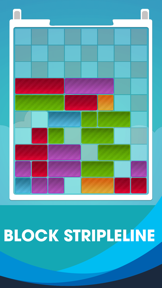
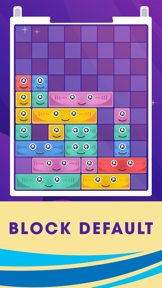


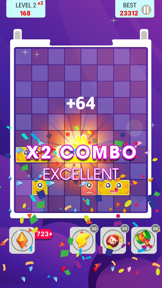
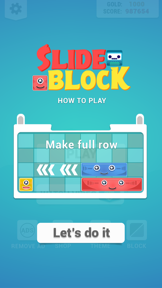
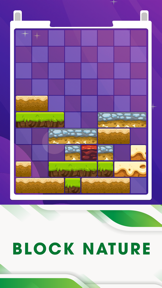
Slide Block: Puzzle Game is a casual grid-based puzzle game for iOS that challenges players to clear lines via horizontal block movement.
The App DNA
What makes this app unique?
The game removes the cognitive friction of complex progression systems, serving users who want a quick, repetitive, and low-stakes puzzle experience.
For Casual puzzle gamers seeking brain training exercises and simple, repetitive gameplay mechanics.
What does it look like?
Key features
Core mechanic requiring players to move blocks horizontally to complete lines.
Non-linear gameplay progression providing infinite replayability.
Selection of 7 distinct block skins for visual variety.
How much does it cost?
The game is free to play with no visible IAP or subscription gates, relying entirely on ad-inventory for revenue.
Velocity
Steady developmentShow more...
Who built it?
Vnstart
13+ apps tracked · Games
 Find Triple City
 Screw Jam: Nut Sort Puzzle
 Solitairecell: Classic Card
 Bounce Jumper EDM Rush
 3D Bubble Puzzle: Match & Pop
 SuDoBlock : Block puzzle game
 Water Color Sort
 Jigsaw Wood Block
 Classic Number Jigsaw
 Dom Dice Merge
 Sort Stack
 Sorter It Puzzle
User Sentiment
What do users think recently?
How are ratings & reviews evolving?
Not enough recent reviews to extract reliable themes yet.
Read the full review analysisCompetition
Competitive landscape for Slide Block : Puzzle Game
How's the Games market?
Slide Block: Puzzle Game maintains a niche position in the casual puzzle category, relying on a free-to-play model without IAP. The absence of live-ops infrastructure makes it a secondary choice compared to high-scale rivals like Woodoku Blast.
Read the market outlookThe rivals identified

By Rovio Entertainment Oyj
As a dominant puzzle-physics title, it competes for the same casual gaming time-share by leveraging high-production value and addictive mechanics.
- Features a robust clan system that drives long-term social retention and daily active engagement.
- Utilizes high-fidelity slingshot physics and cinematic visuals that significantly outperform basic block-sliding mechanics.
- Operates a sophisticated live-ops engine with frequent events that keep the player base constantly returning.
 Woodoku Blast: Block PuzzleContender
 Snake AvoiderContender
 Block Puzzle Saga:Classic CubeContender
 Feed My Cat !Contender
Unlock the head-to-head verdict: where this rival wins, and where it loses.
Access the full report for freeThe Analyst's Read
Key takeaways for Slide Block : Puzzle Game
Where is it heading?
The casual puzzle market is consolidating around titles that offer frequent, time-limited content updates. Slide Block: Puzzle Game remains in a static state, which exposes it to churn as players migrate toward rivals with more active development cycles.
- The current maintenance-only cadence keeps the game stable but prevents it from capturing the rotational interest of the broader casual puzzle market.
- The lack of live-ops events creates a content gap that allows high-cadence rivals to siphon off the core casual user base over time.
The SWOT
- Minimalist, non-intimidating interface lowers the barrier to entry for casual users
- Offline-first design ensures availability in low-connectivity environments
- Introducing a performance-tracking dashboard could differentiate the experience from abstract block-sliding competitors
Next best moves
Ship a level-based progression system because the current endless mode lacks a retention hook → increase DAU/MAU ratio
The counter-intuitive read
The lack of live-ops is not a weakness…
Read the full takeFeature gaps
Structured level-based progression (available in Sudoku 75 Levels but absent here) +1
Since the last report: The analysis transitioned from a descriptive feature list to a critical assessment of the app's retention risks, specifically highlighting the lack of live-ops and progression loops as primary competitive disadvantages.
Bottom line
Slide Block: Puzzle Game serves a specific, low-friction niche, but the lack of a progression loop limits its ability to retain players against live-service rivals. Implementing a basic level-based system would unlock the retention potential required to compete in the casual puzzle market.
Unlock 2 critical frictions, 1 market threat and the analyst’s take.
Access the full report for freeFAQ
Is Slide Block: Puzzle Game suitable for casual play?
How does Slide Block: Puzzle Game compare to Woodoku Blast?
Are there any hidden costs in the game?
What is a good alternative for structured puzzle progression?
Sources
Report last updated