




Telegram Messenger is a cloud-based messaging app for personal and community communication, available on iOS and Android.
The App DNA
What makes this app unique?
Users choose Telegram to bypass the device-tethering limitations of traditional messengers, allowing for persistent, synced access to large-scale communities and media across hardware.
For Users seeking a high-speed, cross-platform messaging solution for personal communication, large community management, and professional collaboration.
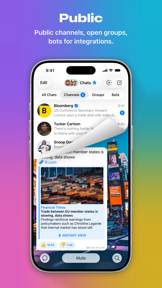
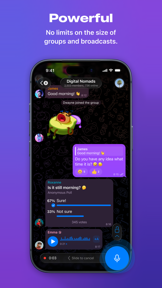
What does it look like?
Key features
Messages and media are stored in the cloud, allowing access from multiple devices simultaneously without needing the primary phone to be online.
Supports group chats with up to 200,000 members, facilitating large-scale community coordination.
API for developers to create bots for task automation and community management.
How much does it cost?
The app operates on a freemium model that provides core messaging features for free while utilizing in-app purchases for additional value.
Velocity
Active developmentopaquesocial featuresplatform expansionShow more...
With 10 distinct versions released over the last few months, the app maintains an active development pace of approximately 0.8 releases per week. While the latest release and several preceding updates provide only generic descriptions, the developer periodically ships significant feature sets, such as Apple Watch integration and AI-driven text editing tools. This pattern suggests a strategy of combining frequent, minor stability patches with larger, feature-rich updates. The development trend remains stable, prioritizing consistent platform maintenance alongside occasional functional expansions.
Who built it?
Telegram FZ-
4 apps tracked · Social Networking
 Telegram X
 Telegram
 Telegram Lite
User Sentiment
What do users think recently?
Fresh user feedback skews frustrated. Users appreciate fast and secure messaging architecture supports large group communication without degrading image or video quality and cross-platform cloud synchronization allows users to switch between devices without losing chat history or data, but report mandatory payment requirements for sms verification codes prevent new users from accessing their accounts.
How are ratings & reviews evolving?
Weekly average review rating
What users say, by theme
- Fast and secure messaging architecture supports large group communication without degrading image or video quality
- Cross-platform cloud synchronization allows users to switch between devices without losing chat history or data
- Mandatory payment requirements for SMS verification codes prevent new users from accessing their accounts
120 of 1426 recent reviews analyzed · high confidence · Frustrated overall
Read the full review analysisUnlock 2 more frustration themes and 1 user request, each backed by review evidence.
Access the full report for freeCompetition
Competitive landscape for Telegram Messenger
How's the Social Networking market?
Telegram Messenger holds a 4.01 rating across 17.4 million total ratings, maintaining a strong global footprint despite recent friction. The reliance on paid SMS verification for logins creates a notable barrier that contrasts with the platform's otherwise open-access messaging model.
Read the market outlookThe rivals identified

By WhatsApp Inc.
WhatsApp competes for the same global messaging audience by serving as the default communication utility, while Telegram targets power users through cloud-native synchronization.
- WhatsApp applies default end-to-end encryption to all messages, whereas Telegram requires manual activation for this security level.
- WhatsApp maintains a lightweight application footprint, ensuring accessibility for users on older hardware.



Unlock the head-to-head verdict: where this rival wins, and where it loses.
Access the full report for freeThe Analyst's Read
Key takeaways for Telegram Messenger
Where is it heading?
Users report: The messaging market is shifting toward identifier-free privacy, leaving Telegram Messenger exposed to niche rivals that do not require phone numbers. If the current paid-login friction persists, the platform risks losing its community-hosting dominance to more accessible alternatives.
- Mandatory paid SMS verification prevents account access, which triggers negative sentiment and forces users toward competitors.
- Cloud-based synchronization remains a unique utility that sustains high-frequency usage for multi-device community managers.
The SWOT
- Cloud-native architecture enables independent multi-device usage
- 200,000-member group capacity establishes category authority
- Implement email-based verification to reduce login friction
Next best moves
Implement email-based verification because paid SMS fees drive login churn → restore new-user conversion
The counter-intuitive read
The reliance on phone-number-based identity, once a security feature…
Read the full takeFeature gaps
Default end-to-end encryption (available in WhatsApp but requires manual activation here) +1
Since the last report: The outlook trend shifted from declining to mixed, reflecting a strategic pivot that acknowledges the platform's cloud-native retention strengths alongside the growing liability of its phone-number-based identity model.
Bottom line
Telegram Messenger's cloud-native architecture remains a powerful retention lever, but mandatory paid login verification is actively eroding the user base. Implementing free verification alternatives would address the primary churn driver and protect the platform's community-hosting authority.
Unlock 2 critical frictions, 1 market threat and the analyst’s take.
Access the full report for freeFAQ
Is Telegram Messenger free to use?
How does Telegram compare to WhatsApp?
Is Telegram safe for my data?
What are some private alternatives to Telegram?
Sources
- [1] Play Store, source
Report last updated