


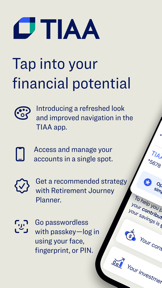


TIAA is a mobile financial management application for retirement and brokerage account holders on iOS and Android.
The App DNA
What makes this app unique?
Users hire TIAA to monitor long-term retirement contributions and execute brokerage trades within their institutional plan, but the app's current design forces them to navigate promotional clutter to reach these core metrics.
For Existing TIAA retirement and brokerage account holders seeking mobile access to their financial portfolios.
What does it look like?
Key features
Displays total portfolio and account balances without requiring a full login session.
Enables buying and selling of equities, ETFs, and mutual funds directly within the mobile interface.
Secures account access using Touch ID or Face ID.
How much does it cost?
The app functions as a free utility for existing TIAA customers to manage retirement and brokerage accounts.
Velocity
Maintenance developmentperformanceopaqueShow more...
The app ships approximately 0.33 releases per month, placing it in the maintenance tier. Development is currently focused exclusively on stability and performance, with no evidence of new features or live-ops content in the recent release history. The publisher utilizes opaque release notes, providing no transparency regarding specific functional changes or improvements. The cadence has remained stable at a low frequency over the analyzed period.
Who built it?
User Sentiment
What do users think recently?
Users report: The recent review mood reads frustrated. Users appreciate biometric login integration provides a fast and secure entry point for daily account balance checks, but report frequent login failures and biometric authentication errors prevent users from accessing their financial accounts reliably.
How are ratings & reviews evolving?
Weekly average review rating
What users say, by theme
- Biometric login integration provides a fast and secure entry point for daily account balance checks
- Frequent login failures and biometric authentication errors prevent users from accessing their financial accounts reliably
70 of 99 recent reviews analyzed · high confidence · Frustrated overall
Read the full review analysisUnlock 2 more frustration themes and 1 user request, each backed by review evidence.
Access the full report for freeCompetition
Competitive landscape for TIAA
How's the Finance market?
TIAA occupies a specialized niche in the retirement sector, but its 3.6-star Android rating across 6,161 reviews lags behind the 4.5-star iOS performance. This rating gap signals that the current mobile interface fails to meet the expectations of the broader Android user base.
Read the market outlookThe rivals identified

By JPMorgan Chase & Co.
Chase is the primary nemesis because it offers a comprehensive, high-frequency banking and investment ecosystem that directly competes for the same retirement and brokerage wallet share as TIAA.
- Offers integrated Zelle payments and credit monitoring, features currently absent from the TIAA mobile experience.
- Provides a highly polished, unified interface for both daily banking and long-term wealth management goals.
- Leverages massive scale to offer advanced financial planning tools that exceed TIAA's core retirement focus.
 Blossom: Social InvestingContender
 Dime! เงินฝาก หุ้น กองทุน ทองContender
 CIBC Mobile WealthContender
 Skandia och SkandiabankenContender
Unlock the head-to-head verdict: where this rival wins, and where it loses.
Access the full report for freeThe Analyst's Read
Key takeaways for TIAA
Where is it heading?
The market for retirement-focused mobile apps is consolidating around platforms that offer both deep institutional integration and modern, intuitive banking utility. TIAA's current posture is exposed: the latest interface update prioritizes promotional visibility over the core financial utility that its users hire the app to provide, creating a churn risk that competitors are actively exploiting.
- Persistent login instability in the latest release prevents users from accessing their accounts, which directly accelerates churn to competitors like Fidelity.
- Aggressive cross-marketing content obscures essential account data, leading to a surge in complaints regarding the new interface layout.
The SWOT
- Deep integration with TIAA-specific retirement plan administration functions as a defensible barrier against generalist bank competitors.
- Implementing automated year-to-date contribution tracking would directly address the #1 requested feature from the user base.
Next best moves
Rebuild biometric authentication logic because login instability is the top-cited frustration theme → increase daily active user retention.
+ 1 more prioritized moveThe counter-intuitive read
The app's "Peek View" feature is a double-edged sword…
Read the full takeFeature gaps
Integrated P2P payments (available in Chase Mobile but absent here) +1
Since the last report: The app's sentiment and user experience have declined due to interface changes that prioritize promotional content and introduce navigation friction, overshadowing core financial utility.
Bottom line
TIAA successfully anchors its users through specialized retirement plan administration, but the current mobile interface prioritizes promotional content over core financial utility, so the PM must restore direct access to portfolio performance data to halt churn.
Unlock 2 critical frictions, 1 market threat, 1 more prioritized move and the analyst’s take.
Access the full report for freeSources
- [1] App Store listing, source
Report last updated