


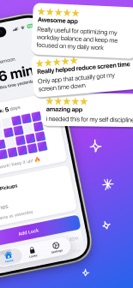


Time Out is a screen time management app for iOS that locks distracting applications behind fitness goals like step counts and calorie targets.
The App DNA
What makes this app unique?
Users struggle with the ease of overriding native screen time limits, so they turn to physical activity requirements to create a friction-heavy barrier that forces a break from digital habits.
For Students and professionals aged 20–35 seeking to replace willpower-based screen time limits with physical activity requirements.
What does it look like?
Key features
Blocks apps until fitness goals are met via Apple Health; primary driver for subscription conversion.
Pairs locks with native iOS Focus modes; increases switching costs by embedding into the OS environment.
Automates recurring daily locks; builds consistent usage habits.
How much does it cost?
Subscription-only model anchored at $3.99/month, positioning Time Out as a low-cost alternative to productivity tools with no ad-supported tier.
Velocity
Active developmentperformanceopaqueShow more...
With two releases in the last 20 days, the app demonstrates an active development cadence. The publisher consistently utilizes opaque release notes, providing only generic references to bug fixes and performance improvements rather than detailing specific feature updates. This pattern suggests that significant changes may be delivered via server-side updates or feature flags rather than through the App Store changelog. The development trend remains stable, focusing on ongoing maintenance and stability.
Who built it?
Matthew Pierce
2 apps tracked · Utilities
 Trippo TFI Dublin bus and Luas
User Sentiment
What do users think recently?
Fresh user feedback skews thrilled. Users appreciate the app provides a more accessible interface for managing daily screen time habits than the native system settings and exercise-based locks provide a unique mechanism for enforcing screen time limits that users find effective.
How are ratings & reviews evolving?
What users say, by theme
- The app provides a more accessible interface for managing daily screen time habits than the native system settings
- Exercise-based locks provide a unique mechanism for enforcing screen time limits that users find effective
2 of 2 recent reviews analyzed · limited sample
Read the full review analysisCompetition
Competitive landscape for Time Out: App blocker and lock
How's the Utilities market?
Time Out occupies a niche in the Utilities category, focusing on fitness-gated productivity. With 12 total ratings and a 4.0-star average, the app maintains a lean profile that prioritizes specific habit-formation mechanics over broad-market utility.
Read the market outlookThe rivals identified
Unlock the deeper market read.
Access the full report for freeThe Analyst's Read
Key takeaways for Time Out: App blocker and lock
Where is it heading?
The digital wellness market is consolidating around tools that offer more than just passive blocking. Time Out is well-positioned to capture the fitness-conscious segment, but its long-term viability depends on moving beyond maintenance updates to deepen its integration with Apple Health and other lifestyle data sources.
- The exercise-based locking mechanism remains a unique differentiator that users find effective for reducing screen time, driving high-quality engagement.
- The current maintenance-only release cadence suggests a stable product state, though it risks falling behind competitors with more aggressive feature-expansion cycles.
The SWOT
- Exercise-based locking mechanism creates a physical barrier to digital distraction.
- Native iOS Focus mode integration increases switching costs by embedding into the OS.
- Localized pricing could capture users who find the $39.99/year price point a barrier.
- Expansion of Apple Health data points could deepen the fitness-habit loop.
Next best moves
Ship expanded Apple Health metrics because current step/calorie limits are the primary retention lever → increase daily active habit
+ 1 more prioritized moveThe counter-intuitive read
The lack of a free tier is a feature, not a bug…
Read the full takeBottom line
Time Out succeeds by turning digital discipline into a fitness game, creating a unique habit loop that native tools ignore. Expanding the fitness metrics supported would deepen this lock-in, ensuring the app remains a distinct utility rather than a redundant system add-on.
Unlock 2 critical frictions, 2 market threats, 1 more prioritized move and the analyst’s take.
Access the full report for freeFAQ
Is Time Out effective for casual users?
How does Time Out compare to native iOS Screen Time?
Does Time Out require a subscription?
Sources
- [1] App Store, source
Report last updated