


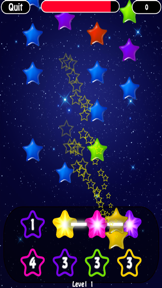

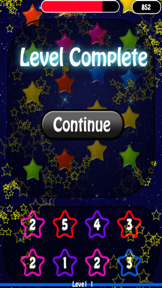
Tiny Star Fall is a casual color-matching puzzle game for iOS that tasks users with forming constellations to earn points.
The App DNA
What makes this app unique?
Users hire the app for low-stakes, repetitive cognitive stimulation that rewards pattern recognition with visual feedback.
For Casual mobile gamers seeking simple, color-matching puzzle mechanics.
What does it look like?
Key features
Connects adjacent star dust holders filled with matching colors to generate points
Tracks high scores via Game Center integration
Increases point requirements per level with visual fireworks rewards
How much does it cost?
The app transitioned from a $0.99 paid model to a free model, prioritizing user acquisition over direct unit sales.
Velocity
Dormant developmentShow more...
5 versions in history. Development pace: zombie.
Who built it?
Chris Egerter
13+ apps tracked · Education
 i Fishing Lite
 i Fishing Saltwater Lite
 i Fishing Fly Fishing Lite
 i Fishing 4
 Zombies : The Last Stand Lite
 i Fishing HD Lite
 i Fishing 3 Lite
 Doodle Fishing Lite
 Mech Pilot Lite
 i Fishing 3 HD Lite
 i Fishing Fly Fishing Edition
 The Counting Game Lite
User Sentiment
What do users think recently?
The recent review mood reads excited.
How are ratings & reviews evolving?
Not enough recent reviews to extract reliable themes yet.
Read the full review analysisCompetition
Competitive landscape for Tiny Star Fall
How's the Education market?
Tiny Star Fall occupies a legacy position in the Education category with a 4.49 rating across 96 reviews. Its lack of recent feature updates relative to high-velocity competitors signals a shift toward maintenance-mode status.
Read the market outlookThe rivals identified
Unlock the deeper market read.
Access the full report for freeThe Analyst's Read
Key takeaways for Tiny Star Fall
Where is it heading?
The educational puzzle market is consolidating around apps that offer adaptive difficulty and high-frequency content updates. Tiny Star Fall remains exposed to these high-velocity rivals, and without a shift to active live-ops, it will likely see a continued decline in relative market share.
- The lack of feature updates since the iOS 11 patch suggests the app is in maintenance mode, which accelerates churn against active competitors.
- The transition to a free-to-play model indicates a pivot to ad-based monetization, though the current content depth may limit long-term ad inventory.
The SWOT
- Game Center integration provides a low-cost social retention loop
- Universal app support reduces friction for multi-device users
- Integration of modern educational metrics to better align with the Education category
- Implementation of daily challenges to drive recurring session frequency
Next best moves
Ship daily challenge mode because current retention loops are static → increase DAU/MAU ratio
The counter-intuitive read
The app's lack of updates is a strategic…
Read the full takeFeature gaps
Adaptive difficulty algorithms (available in Elevate but missing here) +2
Since the last report: The app's competitive position has been downgraded to maintenance-mode status due to a lack of feature iteration, contrasting sharply with high-velocity market entrants.
Bottom line
Tiny Star Fall maintains a stable, classic puzzle loop but risks obsolescence due to a stagnant update cadence, so the PM should prioritize a live-ops refresh to defend the user base against high-frequency educational puzzle entrants.
Unlock 2 critical frictions, 2 market threats and the analyst’s take.
Access the full report for freeReport last updated