


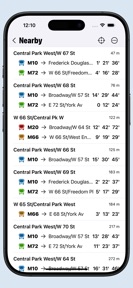

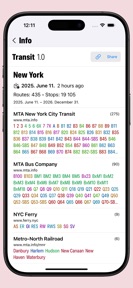


Transit: offline schedules is a travel utility providing local, offline access to public transport timetables for commuters on Android and iOS.
The App DNA
What makes this app unique?
The app removes the friction of cellular data dependency for transit planning, serving users in regions where connectivity is unreliable or expensive.
For Daily public transit commuters and travelers in regions with inconsistent internet connectivity.
What does it look like?
Key features
Stores public transport timetables locally for use without an active data connection, driving retention in areas with poor coverage.
Provides schedule data for transit agencies across North America, Europe, Australia, and South America, expanding the addressable market.
Uses device GPS to identify nearby transit stops, extending session utility during travel.
How much does it cost?
The app operates on a free, ad-supported model with no identified in-app purchases or subscription tiers.
Velocity
Maintenance developmentperformanceShow more...
The app is currently in a maintenance phase, with only two releases identified across the last 204 days. The latest release occurred 110 days ago, and the overall development cadence is infrequent. There is no evidence of active feature development or live-ops engagement, as recent updates have been limited to minor technical adjustments. The development trend is stable at a low-frequency maintenance level.
Who built it?
Robert Bajzat
3 apps tracked · Travel
 Transit: offline schedules
 Hungarian dictionaries
User Sentiment
What do users think recently?
Recent user voice shows a mixed sentiment. Users appreciate offline timetable access provides reliable transit information without requiring a constant cellular data connection and minimalist interface and small application size ensure quick performance on older or low-storage mobile devices, but report recent updates removed previously available customization options and stop numbering, frustrating long-term power users.
How are ratings & reviews evolving?
What users say, by theme
- Offline timetable access provides reliable transit information without requiring a constant cellular data connection
- Minimalist interface and small application size ensure quick performance on older or low-storage mobile devices
- Ad-free experience in previous versions fostered strong user loyalty and daily reliance for transit planning
- Recent updates removed previously available customization options and stop numbering, frustrating long-term power users
50 of 50 recent reviews analyzed · high confidence · Mixed overall
Read the full review analysisUnlock 2 more frustration themes and 3 user requests, each backed by review evidence.
Access the full report for freeCompetition
Competitive landscape for Transit: offline schedules
How's the Travel market?
Transit: offline schedules maintains a 4.3-star rating across 1,266 reviews on Android, reflecting a stable but declining sentiment following recent feature removals. The lack of updates for 110 days signals a maintenance-mode posture that leaves the app vulnerable to transit authorities offering real-time data.
Read the market outlookThe rivals identified
Unlock the deeper market read.
Access the full report for freeThe Analyst's Read
Key takeaways for Transit: offline schedules
Where is it heading?
Users report: The transit utility market is consolidating around official transit authority apps that offer real-time data, leaving Transit: offline schedules exposed due to its reliance on static, potentially outdated, offline data. The current maintenance posture, combined with negative sentiment from power users, signals a decline in long-term viability unless the developer pivots to address schedule accuracy and feature parity.
- The 110-day update gap and removal of features suggest a shift toward maintenance-mode, eroding the app's competitive edge against official transit apps.
- User dissatisfaction regarding the introduction of ads and removal of customization creates a churn risk that current stability updates cannot resolve.
The SWOT
- Offline-first architecture removes connectivity dependency for transit planning
- Expansion into smaller transit systems addresses specific user requests
Next best moves
Restore removed customization options because they are the top-cited frustration theme → improve retention
+ 1 more prioritized moveThe counter-intuitive read
The app's offline-first design is a retention lever…
Read the full takeSince the last report: The app expanded to iOS and refined its competitive narrative to acknowledge the threat posed by real-time data from official transit authorities. The core maintenance-mode status remains unchanged, with no new feature development reported.
Bottom line
Restoring customization and ensuring schedule accuracy would address the primary churn drivers identified in user feedback. Prioritizing these fixes is necessary to maintain the app's utility against official transit authority alternatives.
Unlock 2 critical frictions, 1 market threat, 1 more prioritized move and the analyst’s take.
Access the full report for freeFAQ
Is Transit: offline schedules good for daily commuters?
Does Transit: offline schedules work without internet?
Are there intrusive ads in the app?
Sources
Report last updated