


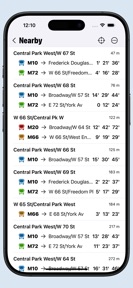

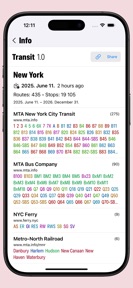


Transit: offline schedules is a travel utility providing offline public transport timetables for global cities on iOS.
The App DNA
What makes this app unique?
The app serves commuters in regions with unreliable network infrastructure or travelers seeking to minimize data roaming costs by removing the connectivity dependency required by cloud-reliant rivals.
For Public transit commuters and travelers who require reliable, offline access to local transport schedules.
What does it look like?
Key features
Provides transit timetables for global cities without requiring an active internet connection.
Includes public transport schedules for over 100 cities across North America, Europe, and Australia.
Uses device GPS to identify relevant transit schedules for the user's current location.
How much does it cost?
The app operates on a free, ad-supported model with no visible subscription or premium tier.
Velocity
Dormant developmentperformanceShow more...
Development has stalled, with no new feature builds or updates released in over seven months. The latest release, which focused solely on minor privacy adjustments, is the only activity recorded in the current window. Given the lack of recent updates, the app is classified as a zombie project.
Who built it?
Robert Bajzat
3 apps tracked · Travel
 Transit: offline schedules
 Hungarian dictionaries
User Sentiment
What do users think recently?
How are ratings & reviews evolving?
Not enough recent reviews to extract reliable themes yet.
Read the full review analysisCompetition
Competitive landscape for Transit: offline schedules
How's the Travel market?
Transit: offline schedules occupies a niche utility segment, serving commuters in regions with unreliable network infrastructure. The lack of recent updates over 215 days signals a maintenance-only posture relative to the broader travel category.
Read the market outlookThe rivals identified
Unlock the deeper market read.
Access the full report for freeThe Analyst's Read
Key takeaways for Transit: offline schedules
Where is it heading?
The travel utility market is consolidating around platforms that provide real-time service alerts and dynamic routing. Transit: offline schedules remains exposed due to its 215-day update gap, which prevents it from answering the feature-parity demands of modern commuters.
- The 215-day update gap suggests a maintenance-only posture, which will erode user trust as transit schedules change and data becomes stale.
- Lack of real-time transit data integration limits the app's utility against modern competitors, accelerating churn pressure into the next quarter.
The SWOT
- Offline-first architecture functions as a defensible barrier against cloud-dependent transit apps in low-connectivity markets
- Localized UI and schedule expansion in emerging markets could capture users underserved by cloud-reliant competitors
Next best moves
Audit transit data sources because the 215-day update gap risks data staleness → maintain utility baseline
The counter-intuitive read
The offline-first design is a retention lever in…
Read the full takeBottom line
The offline-first utility remains a functional niche, but the 215-day update gap risks data staleness that will drive churn toward real-time transit alternatives. Maintaining data accuracy is the only way to defend the current user base against more dynamic competitors.
Unlock 1 critical friction, 1 market threat and the analyst’s take.
Access the full report for freeFAQ
Does Transit: offline schedules work without an internet connection?
Is Transit: offline schedules free to use?
What are the limitations of Transit: offline schedules?
What is a free alternative to Transit: offline schedules?
Sources
- [1] App Store, source
Report last updated