


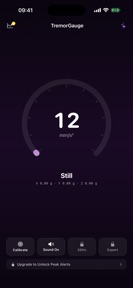


TremorGauge is a vibration reference meter for iPhone that uses the built-in accelerometer to estimate intensity for equipment and surface checks.
The App DNA
What makes this app unique?
It removes the need for expensive, external piezoelectric hardware for users who only require relative vibration awareness rather than regulatory-grade data.
For Users performing relative vibration checks on machinery, vehicles, or furniture who require a portable, non-laboratory tool.
What does it look like?
Key features
Real-time estimation of vibration intensity in mm/s² using the internal iPhone accelerometer.
High-rate data collection mode that samples at 5x the speed of the free tier.
Exports full session data including timestamps and X, Y, Z axis values.
How much does it cost?
Freemium model gates technical data analysis and high-frequency sampling behind a subscription to monetize power users.
Velocity
Maintenance developmentUX improvementsperformanceShow more...
TremorGauge currently operates on a maintenance cadence, with only one release shipped in the last 45 days. Development is focused on incremental UX improvements and clarifying measurement documentation rather than significant feature expansion. The current release pattern suggests a stable, low-frequency update cycle aimed at minor refinements and stability. No evidence of live-ops or rapid feature iteration is present.
Who built it?
杰 向
3 apps tracked · Utilities
 LumenLab - Lux Meter
 DeepWave - Binaural Beats
User Sentiment
What do users think recently?
How are ratings & reviews evolving?
Not enough recent reviews to extract reliable themes yet.
Read the full review analysisCompetition
Competitive landscape for TremorGauge - Vibration
How's the Utilities market?
TremorGauge occupies a specialized niche in the Utilities category, providing a software-only vibration reference tool for iPhone users. The absence of direct competitors in the immediate store rankings suggests a focus on organic discovery rather than chart-driven acquisition.
Read the market outlookThe rivals identified
Unlock the deeper market read.
Access the full report for freeThe Analyst's Read
Key takeaways for TremorGauge - Vibration
Where is it heading?
The market for consumer-grade diagnostic tools remains stable, with users increasingly favoring privacy-focused, offline-first utilities. TremorGauge is well-positioned to maintain its niche as long as it continues to refine its calibration accuracy, which is the primary barrier to user trust.
- The latest release introduced session reporting, which indicates that the developer is actively refining the core utility for power users.
- The maintenance-focused update cadence suggests a stable, low-overhead product strategy rather than an aggressive expansion into new categories.
The SWOT
- Fully offline sensor processing ensures data privacy
- Zero network dependency removes connectivity barriers
- Localized pricing could capture high-ARPU markets
Next best moves
Ship a visual tutorial for baseline calibration because users often struggle with ambient noise subtraction → increase measurement accuracy
+ 1 more prioritized moveThe counter-intuitive read
TremorGauge's lack of laboratory-grade certification is its primary strength…
Read the full takeSince the last report: TremorGauge has pivoted its messaging to frame the absence of laboratory-grade certification as a strategic advantage, while reallocating development resources to prioritize calibration education over export utility.
Bottom line
TremorGauge serves a niche need for relative vibration awareness, and its offline-first architecture provides a defensible barrier against ad-supported rivals. Prioritizing calibration guidance will improve the utility of the free tier, which is the primary funnel for premium conversions.
Unlock 1 critical friction, 1 market threat, 1 more prioritized move and the analyst’s take.
Access the full report for freeFAQ
Is TremorGauge accurate enough for professional engineering work?
Does TremorGauge require an internet connection to function?
What features are included in the premium subscription?
Sources
- [1] App Store, source
Report last updated