


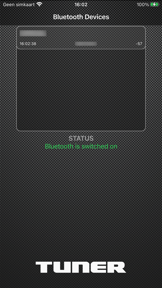


Tuner-App is a utility for iOS that provides remote control and calibration for IOTuning vehicle hardware modules.
The App DNA
What makes this app unique?
It removes the friction of manual hardware adjustments by providing a digital interface for throttle and idle control.
For Car enthusiasts, motorhome owners, and fleet operators seeking to modify vehicle throttle response or improve auxiliary power management.
What does it look like?
Key features
Adjusts accelerator pedal sensitivity via wireless module and app control.
Increases engine idle speed to improve auxiliary battery charging for motorhomes and commercial vehicles.
Software-based security features to limit vehicle responsiveness or immobilize the pedal.
How much does it cost?
The app functions as a controller for physical hardware, with revenue generated through direct sales of tuning modules rather than in-app subscriptions.
Velocity
Dormant developmentperformanceShow more...
Tuner-App has entered a zombie state, with no updates or feature releases in the last 286 days. The development momentum has effectively ceased, as the only recorded activity in the analyzed window was a minor compliance update. There is no evidence of ongoing maintenance or active support for the platform.
Who built it?
User Sentiment
What do users think recently?
How are ratings & reviews evolving?
Not enough recent reviews to extract reliable themes yet.
Read the full review analysisCompetition
Competitive landscape for Tuner-App
How's the Utilities market?
Tuner-App serves as a proprietary utility for IOTuning hardware, operating within the automotive utilities segment.
Read the market outlookThe rivals identified
Unlock the deeper market read.
Access the full report for freeThe Analyst's Read
Key takeaways for Tuner-App
Where is it heading?
The automotive utility market is shifting toward integrated fleet management and data-driven performance monitoring. Tuner-App remains tethered to a hardware-first model, which provides a stable revenue base but limits its ability to compete with software-centric rivals that offer cloud-based analytics.
- The nine-month release gap suggests a maintenance-only posture, which limits the ability to capture new market segments through software innovation.
- Hardware-dependent revenue models provide stability but prevent the app from scaling as an independent software product.
The SWOT
- Hardware-dependent revenue model ensures high-intent user acquisition.
- Universal vehicle compatibility expands addressable market to EVs and commercial fleets.
- Software-based security features offer a path to differentiate from generic throttle controllers.
- Fleet management data could unlock B2B partnership potential.
Next best moves
Audit the current codebase for stability because the nine-month release gap risks technical debt accumulation → maintain baseline functionality.
+ 1 more prioritized moveThe counter-intuitive read
The lack of software updates is a feature, not a bug…
Read the full takeBottom line
Focusing on B2B fleet analytics would unlock a recurring value proposition that hardware-only throttle tuning lacks, shifting the product from a one-time utility to a long-term operational tool.
Unlock 2 critical frictions, 2 market threats, 1 more prioritized move and the analyst’s take.
Access the full report for freeFAQ
Does Tuner-App work without the hardware module?
Is Tuner-App compatible with electric vehicles?
What is the main difference between Tuner-App and generic throttle controllers?
Sources
Report last updated