


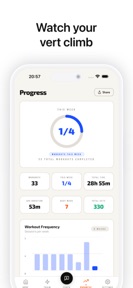

Vertical Jump Trainer: JumpKit is a mobile training tool for athletes that uses AI to grade jump mechanics and generate adaptive plyometric programs on iOS.
The App DNA
What makes this app unique?
The product removes the cost and scheduling friction of hiring a human jump coach by providing automated, data-backed training cycles that adjust to user progress.
For Athletes in sports like basketball, volleyball, and soccer seeking data-driven, personalized vertical jump training without a human coach.
What does it look like?
Key features
AI-driven measurement of jump mechanics used as a premium-tier gate to drive subscription conversion.
Training plans that adjust volume based on re-test results to reduce churn by preventing plateaus.
Automated A–F grading system that encourages repeated testing and video uploads to increase app usage frequency.
How much does it cost?
Subscription-only model anchored at $19.99/month, utilizing a 3-day trial on the annual plan to lower the barrier for high-intent users.
Velocity
Maintenance developmentopaqueShow more...
The app has shipped only a single release in the observed window, resulting in a maintenance-tier cadence of approximately 0.09 releases per week. With no subsequent updates or feature additions since the initial launch 73 days ago, development activity appears to have stalled. The lack of version history beyond the initial release provides no evidence of ongoing support or iterative improvements.
Who built it?
User Sentiment
What do users think recently?
How are ratings & reviews evolving?
Not enough recent reviews to extract reliable themes yet.
Read the full review analysisCompetition
Competitive landscape for Vertical Jump Trainer: JumpKit
How's the Health & Fitness market?
Vertical Jump Trainer: JumpKit occupies a specialized niche in the Health & Fitness category, targeting high-intent athletes with a premium $99.99/year subscription.
Read the market outlookThe rivals identified
Unlock the deeper market read.
Access the full report for freeThe Analyst's Read
Key takeaways for Vertical Jump Trainer: JumpKit
Where is it heading?
The vertical jump training market is shifting toward low-friction, social-first experiences. Vertical Jump Trainer: JumpKit's current maintenance-mode cadence leaves it exposed to more active competitors who can iterate on user feedback and social features.
- The 73-day update silence signals a maintenance-only posture, which erodes user trust in the long-term viability of the training program.
- The subscription-only model targets high-intent athletes, but the lack of free-tier content limits the ability to scale the user base against social-media rivals.
The SWOT
- AI-driven biomechanical analysis automates coaching feedback
- Adaptive programming prevents training plateaus
- Automated A-F grading encourages repeated video uploads
- Localized pricing could capture international student-athlete segments
- Social sharing features could drive organic acquisition
- Freemium content tier could increase user acquisition
Next best moves
Ship a limited free-tier to increase top-of-funnel acquisition because the current subscription-only model limits reach → increase user base
+ 1 more prioritized moveThe counter-intuitive read
The lack of updates is a strategic risk: in the high-intent fitness segment…
Read the full takeSince the last report: The product management strategy has shifted from a passive maintenance posture to an active development roadmap, specifically targeting the introduction of a free tier to address high-funnel conversion barriers.
Bottom line
Vertical Jump Trainer: JumpKit's AI-driven coaching provides a clear value proposition, but the subscription-only model and lack of updates limit its growth. Introducing a free tier would unlock the top-of-funnel, allowing the product to compete with free social-media training content.
Unlock 3 critical frictions, 3 market threats, 1 more prioritized move and the analyst’s take.
Access the full report for freeSources
- [1] App Store, source
Report last updated