


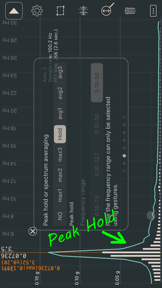


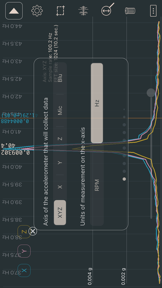


Vibration Analysis is a diagnostic utility for engineers and hobbyists that uses device accelerometers to perform spectral analysis on rotating machinery.
The App DNA
What makes this app unique?
The app removes the need for expensive, bulky diagnostic hardware by enabling real-time vibration monitoring directly on mobile devices.
For Engineers, technicians, and hobbyists requiring on-the-go vibration diagnostics for rotating machinery and structural components.
What does it look like?
Key features
Connects to external Bluetooth accelerometers or analog sensors via headphone jack for high-precision data collection
Performs real-time spectral analysis including Fast Fourier Transform and Power Spectral Density calculations
Exports measurement results as text, CSV, or WAV files for external processing
How much does it cost?
Freemium model gates advanced features and professional-grade sensor support behind a one-time in-app purchase.
Velocity
Maintenance developmentUX improvementsperformanceShow more...
The app ships approximately 0.15 releases per week, placing it firmly in the maintenance tier. Development is currently focused on technical stability and minor UI refinements rather than new content or features. The latest release on Android introduced functional improvements to calculations and unit preferences, while the iOS release was limited to generic bug fixes. There is no evidence of live-ops activity or a high-frequency release cycle.
Who built it?
Dmitriy Kharutskiy
11 apps tracked · Utilities
 Talking Speedometer
 Video tachometer for business
 Speedometer, Speed Limit Alert
 Remote Camera Control via Air
 Video tachometer
 DIY Metal Detector (Au,Ag,Fe)
 Offline Photo Storage
 Strobe tachometer (RPM meter)
 DIY Anemometer (Wind Meter)
 Sound Spectrum Analysis
User Sentiment
What do users think recently?
Fresh user feedback skews mixed. Users appreciate high-fidelity vibration analysis provides immediate frequency data for diagnosing mechanical issues in household appliances and clean interface and responsive visualization plots allow users to quickly identify vibration patterns during testing, but report subscription and paywall mechanics frustrate users who encounter locked features after initial payment.
How are ratings & reviews evolving?
What users say, by theme
- High-fidelity vibration analysis provides immediate frequency data for diagnosing mechanical issues in household appliances
- Clean interface and responsive visualization plots allow users to quickly identify vibration patterns during testing
- Portable seismogram functionality enables users to detect and analyze low-frequency vibrations in their immediate environment
- Subscription and paywall mechanics frustrate users who encounter locked features after initial payment
64 of 67 recent reviews analyzed · high confidence · Mixed overall
Read the full review analysisUnlock 2 more frustration themes and 3 user requests, each backed by review evidence.
Access the full report for freeCompetition
Competitive landscape for Vibration analysis
How's the Utilities market?
Vibration Analysis operates in the industrial utility space, currently holding a 3.98-star rating across 343 total platform ratings. The lack of recent feature-heavy updates suggests a maintenance-mode posture, leaving the app vulnerable to industrial rivals that offer integrated hardware-software solutions.
Read the market outlookThe rivals identified

By ACE Stoßdämpfer GmbH
Vibrochecker directly targets the industrial maintenance niche by providing vibration measurement tools specifically for mechanical damping and machine health, overlapping with this app's core diagnostic functionality.
- Provides specialized damping suggestions that directly assist engineers in selecting hardware for vibration reduction.
- Includes built-in measurement archiving, allowing users to track machine health trends over extended periods.
Unlock the head-to-head verdict: where this rival wins, and where it loses.
Access the full report for freeThe Analyst's Read
Key takeaways for Vibration analysis
Where is it heading?
The industrial diagnostic market is consolidating around apps that offer integrated hardware-software solutions, leaving Vibration Analysis exposed due to its manual-focused, maintenance-only update cycle. Unless the app addresses its monetization friction and recording limitations, it will continue to lose professional users to rivals that provide more reliable, end-to-end maintenance workflows.
- Opaque paywall mechanics drive high-frequency user complaints, which erodes trust and limits the conversion of professional users.
- The current maintenance-only release cadence prevents the app from answering the feature-rich updates of emerging industrial utility rivals.
The SWOT
- Technical authority in spectral analysis via FFT and PSD
- Bluetooth sensor integration enables remote monitoring
- Specialized diagnostic tools like the stroboscope differentiate the app
- Localized support for international markets to compete with LiTime
- Integration of gyroscope data for angular rate analysis
Next best moves
Audit paywall logic because users report locked features after payment → reduce negative sentiment
+ 1 more prioritized moveThe counter-intuitive read
The app's stability issues are a competitive advantage for rivals…
Read the full takeFeature gaps
Specialized damping suggestions (available in Vibrochecker) +2
Since the last report: Users report: Monetization transparency and technical stability have emerged as critical friction points, with user sentiment increasingly characterizing the paywall as deceptive. The app remains in a maintenance-only cycle, causing it to lose ground to industrial rivals that offer more robust, end-to-end diagnostic workflows.
Bottom line
The technical diagnostic engine provides a defensible niche, but monetization friction currently invalidates the professional value proposition. Resolving the paywall transparency and recording limits would unlock the industrial maintenance segment, which is currently being siphoned by established industrial rivals.
Unlock 3 critical frictions, 2 market threats, 1 more prioritized move and the analyst’s take.
Access the full report for freeFAQ
Is Vibration Analysis suitable for professional engineering work?
How does Vibration Analysis compare to Vibrochecker?
Are there hidden costs in the app?
What are some alternatives for machine monitoring?
Sources
Report last updated