




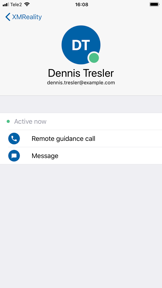
XMReality is a remote guidance platform for industrial field service, providing AR-powered visual tools on mobile and enterprise hardware.
Product velocity
Dormant
Daily rank 🇺🇸
—
Business
Sentiment
5.0
4 reviews
Nemesis

Meeting - Video Conference
The App DNA
What makes this app unique?
Field service teams hire XMReality to solve complex technical problems remotely, as the hands-overlay mechanism provides visual clarity that standard video calls cannot replicate.
For Field service organizations, manufacturing companies, and industrial maintenance teams requiring remote technical guidance.
What does it look like?
Key features
Visual AR tool allowing remote experts to project hand gestures onto the field worker's live video feed
Allows external users to join a support session via a web link without requiring app installation or account creation
Freezes the live video stream to allow for detailed inspection of static images or serial numbers in low-bandwidth conditions
How much does it cost?
B2B subscription model focused on enterprise licensing, anchored by demo-led sales cycles rather than public self-serve pricing.
Velocity
Dormant developmentperformanceShow more...
The development momentum for XMReality is currently classified as zombie status. The last recorded release occurred on August 29, 2024, which is well beyond the 3-month threshold for active development. There have been no feature updates or bug fixes identified in the observed data for over 260 days. The lack of recent activity suggests the application is currently in a state of abandonment or extreme long-term maintenance.
Who built it?
User Sentiment
What do users think recently?
Fresh user feedback skews thrilled. Users appreciate drawing and pointer functionality provides high precision for remote guidance sessions and hands overlay feature enables clear visual communication between remote participants.
How are ratings & reviews evolving?
What users say, by theme
- Drawing and pointer functionality provides high precision for remote guidance sessions
- Hands overlay feature enables clear visual communication between remote participants
- Hand overlay tracking becomes unstable and inverted on lower performance hardware
3 of 3 recent reviews analyzed · limited sample
Read the full review analysisUnlock 1 more frustration theme, each backed by review evidence.
Access the full report for freeCompetition
Competitive landscape for XMReality
How's the Business market?
XMReality occupies a specialized industrial niche, avoiding the general video conferencing chart battles to focus on high-touch enterprise service. The lack of public pricing and reliance on custom demo cycles confirms its position as a B2B-first utility rather than a mass-market tool.
Read the market outlookThe rivals identified
By DOSA Apps
This app competes directly by offering high-volume, general-purpose video communication that captures the same business user base looking for instant remote connectivity.
- Massive user base and network effects create a standard for instant, frictionless business communication.
- High-definition performance optimized for large-scale meetings exceeds the specialized, niche focus of XMReality.
 Librestream Onsight ConnectContender
 SightCallContender
 Vonage Enterprise for iPad ADContender
 Vonage Enterprise for ADContender
Unlock the head-to-head verdict: where this rival wins, and where it loses.
Access the full report for freeThe Analyst's Read
Key takeaways for XMReality
Where is it heading?
The remote guidance market is consolidating around integrated workflow solutions, forcing XMReality to balance its specialized AR focus with broader enterprise ecosystem requirements. The current stability-focused update cadence is necessary to defend the core product, but the lack of CRM-level integration leaves the app exposed to competitors like SightCall.
- Recent updates resolved Android permission issues, which should reduce the friction reported by new recipients during initial connection.
- Hand overlay tracking instability on entry-level hardware continues to erode the utility of the core AR feature for field workers.
The SWOT
- Hands-overlay mechanism justifies enterprise-grade licensing
- Guest-access link reduces friction for B2B end-customer support
- Untapped education partnerships for B2B distribution
- Integration of IoT data overlays to match Librestream capabilities
Next best moves
Audit permission request flow because recipient suspicion is a top complaint → reduce onboarding drop-off
+ 1 more prioritized moveThe counter-intuitive read
The reliance on enterprise-grade hardware is a moat, not a weakness…
Read the full takeFeature gaps
Advanced IoT data overlay (available in Librestream Onsight Connect) +1
Since the last report: The addition of user sentiment data has clarified product friction points, leading to a strategic pivot toward permission transparency and tracking stability on lower-end hardware.
Bottom line
XMReality holds its industrial niche through superior AR-guidance tools, but the high-friction permission onboarding and hardware-dependent tracking stability threaten enterprise adoption, so the PM should prioritize permission transparency to protect the B2B conversion funnel.
Unlock 2 critical frictions, 2 market threats, 1 more prioritized move and the analyst’s take.
Access the full report for freeReport last updated