


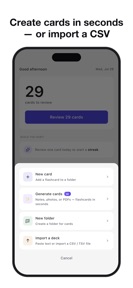


ZapCards: Active Recall is an education app for students that converts notes, photos, and PDFs into flashcards using generative models on iOS.
The App DNA
What makes this app unique?
The app removes the manual friction of typing study sets, allowing users to spend time on memory retrieval rather than content preparation.
For Students and lifelong learners who need to convert dense study materials into active recall flashcards.
What does it look like?
Key features
Converts lecture notes, textbook photos, or PDFs into flashcards using generative models.
Schedules card reviews based on the SuperMemo SM-2 algorithm to optimize memory retention.
Supports text, images, and voice recordings within individual flashcards.
How much does it cost?
The freemium model uses a usage-based gate on AI generation to drive conversion to the Pro tier.
Velocity
Maintenance developmentnew contentUX improvementsShow more...
With only one release in the observed window and a last update occurring 8 days ago, the app maintains a maintenance-level cadence. Development is currently focused on integrating AI-driven content creation tools and refining core infrastructure like iCloud sync. The latest release represents a significant feature addition, though the overall frequency of updates remains low. The publisher is actively iterating on user-facing features rather than relying on opaque maintenance patches.
Who built it?
User Sentiment
What do users think recently?
How are ratings & reviews evolving?
Not enough recent reviews to extract reliable themes yet.
Read the full review analysisCompetition
Competitive landscape for ZapCards: Active Recall
How's the Education market?
ZapCards holds a 4.33 rating on the iOS platform with a limited sample of 3 ratings, indicating an early-stage market presence.
Read the market outlookThe rivals identified
Unlock the deeper market read.
Access the full report for freeThe Analyst's Read
Key takeaways for ZapCards: Active Recall
Where is it heading?
The education app market is consolidating around automated study tools that reduce manual input time. ZapCards is currently positioned as an early-stage entrant, and its ability to maintain growth will depend on moving beyond maintenance-mode updates to address user-requested features.
- The latest release introduced AI-powered deck generation, signaling a shift toward automated content creation over manual entry.
The SWOT
- AI-powered ingestion of textbook photos reduces the cognitive cost of deck creation
- Usage-based gate on AI generation provides a clear path for revenue expansion
Next best moves
Ship iterative interface improvements because the current maintenance cadence risks user churn → increase retention
The counter-intuitive read
The reliance on AI deck generation is a vulnerability, not just a feature…
Read the full takeSince the last report: The analysis reflects a strategic pivot in development priorities, moving from a focus on community-driven growth to a defensive stance on UI stability and AI-related margin management.
Bottom line
ZapCards' AI-driven ingestion mechanism effectively lowers the barrier to entry for active recall, but the current maintenance-mode cadence risks stagnation.
Unlock 1 critical friction, 1 market threat and the analyst’s take.
Access the full report for freeFAQ
Is ZapCards suitable for casual learners?
Does ZapCards offer a free version?
What happens when I run out of AI generations?
Sources
- [1] App Store, source
Report last updated