


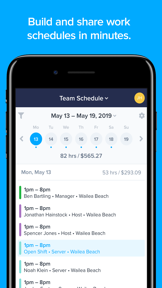

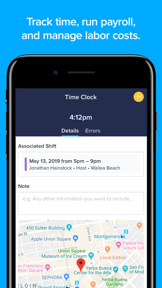
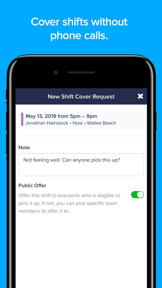
ZoomShift is an employee scheduling and time-tracking application for SMBs, available on iOS and Android.
The App DNA
What makes this app unique?
Managers hire ZoomShift to reduce administrative time spent on shift assignments and payroll, while employees use it to track their own hours and availability.
For Small to medium-sized businesses in retail, restaurants, and service industries that rely on hourly staff.
What does it look like?
Key features
Compares static budget against real-time schedule data to identify overtime, acting as a B2B unlock for cost-conscious SMB owners.
Tracks employee hours via mobile device with GPS location, serving as a primary retention loop for payroll accuracy.
How much does it cost?
The 20-employee cap functions as a conversion trigger, forcing growing SMBs into paid tiers to maintain operational continuity.
Velocity
Maintenance developmentperformanceopaqueShow more...
The app exhibits a low-frequency release cadence, with only two updates recorded over the last 14 months. The latest release occurred in September 2025, following a significant gap since the previous update in April 2025. Development appears to be in a maintenance phase, as all recent release notes are generic and lack evidence of new features or live operations. The current pace is approximately 0.03 releases per week, indicating a focus solely on stability and bug fixes.
Who built it?
User Sentiment
What do users think recently?
The recent review mood reads frustrated. Users appreciate simple and straightforward time tracking interface helps employees manage their daily work schedules effectively, but report mandatory location services and gps tracking requirements create friction for employees clocking in and out.
How are ratings & reviews evolving?
What users say, by theme
- Simple and straightforward time tracking interface helps employees manage their daily work schedules effectively
- Mandatory location services and GPS tracking requirements create friction for employees clocking in and out
63 of 103 recent reviews analyzed · high confidence · Frustrated overall
Read the full review analysisUnlock 1 more frustration theme and 1 user request, each backed by review evidence.
Access the full report for freeCompetition
Competitive landscape for ZoomShift Employee Scheduling
How's the Business market?
ZoomShift holds a #165 Free rank in the Business category, but its 2.8-star iOS rating across 60 reviews signals that technical instability is hindering its growth relative to category leaders.
Read the market outlookThe rivals identified

By Tanda
Workforce.com directly competes for the same SMB and enterprise scheduling market, offering comprehensive labor management that overlaps with ZoomShift’s core scheduling and time-tracking functionality.
- Advanced award interpretation engine automates complex labor compliance and payroll calculations for global businesses.
- Demand-based rostering uses historical sales data to predict staffing needs more accurately than manual forecasting.
- Deep integration ecosystem supports complex enterprise payroll systems that ZoomShift currently lacks in its roadmap.
 ScheduleFlex by ShiftboardNemesis
 OptimoRoute DriverContender
 FieldPulseContender
 Skedulo PlusContender
 mHelpDeskContender
 CosmoLexContender
 Field SquaredContender
 Guusto - Recognition & RewardsContender
Unlock the head-to-head verdict: where this rival wins, and where it loses.
Access the full report for freeThe Analyst's Read
Key takeaways for ZoomShift Employee Scheduling
Where is it heading?
The SMB scheduling market is consolidating around platforms that offer automated compliance and holistic business management. ZoomShift's maintenance-mode posture leaves it exposed to rivals that solve for payroll complexity, so the app must pivot to stability and security to retain its current user base.
- Frequent app freezes during time-entry erode the daily active habit, which compounds the rating drag already visible on Android.
- Workforce.com's automated compliance engine pulls SMB managers away from manual scheduling, accelerating churn pressure on ZoomShift's core base.
The SWOT
- Lightweight interface enables rapid SMB adoption
- GPS time clock creates payroll-accuracy retention loop
- Target niche field-service industries with specialized compliance
- Integrate biometric security to increase enterprise trust
Next best moves
Rebuild clock-in/out flow to eliminate freezing because it is the #1 churn risk → increase daily active habit
+ 1 more prioritized moveThe counter-intuitive read
ZoomShift's 20-employee free tier is not just a growth lever…
Read the full takeFeature gaps
Automated award interpretation (available in Workforce.com) +1
Since the last report: The competitive outlook has declined due to persistent technical instability and increased pressure from competitors offering more comprehensive business management tools.
Bottom line
ZoomShift wins on simplicity for small teams, but technical instability during time-entry is eroding its user base, so the team must prioritize stability over new features to prevent churn to more robust competitors.
Unlock 3 critical frictions, 2 market threats, 1 more prioritized move and the analyst’s take.
Access the full report for freeFAQ
Is ZoomShift suitable for small businesses with hourly staff?
How does ZoomShift compare to Workforce.com?
Does ZoomShift require GPS access?
What are some alternatives to ZoomShift?
Sources
Report last updated